New Techniques Could Remove Barriers to 3-D Printing
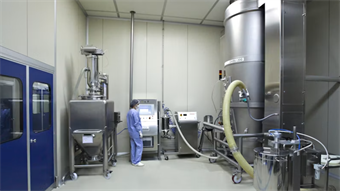
Mike Farish | September 13, 2016 Infinite Build demonstration machine. Image source: Stratasys
The basic principle underlying the set of techniques collectively known as additive manufacturing (or increasingly as 3-D printing) is well-known is that they all involve creating physical objects through the application of material in an incremental layer-by-layer process.
Both the advantages and disadvantages of this approach are well recognized. In the first instance they include the ability to make one-of-a-kind or small runs of parts whether for design verification or actual production, and to do so in a manner that is economically feasible. In the second, they recognize that the size of parts that can be made is limited by the confines of the machine itself and that there also sometimes can be restrictions on their geometry.
But in recent weeks, Stratasys has revealed the details of two prototype development projects in which both of these inhibiting factors have been mitigated and, in one respect, effectively abolished.
(Watch a video of the new additive manufacturing techniques.)
This has been achieved by enabling the process – in this case, that of fused deposition modeling (FDM) in which a liquid polymer material is extruded through a nozzle – to take place outside of the confines of a machine tool cabinet. Moreover two of the biggest engineering companies in the world – Boeing and Ford – have worked to help ensure that the 3-D printing advancements present potential solutions for real commercial requirements. And a third – control system provider Siemens – helped develop robotic capabilities.
Expanding the Scope
The two projects are called, respectively, the Infinite-Build and Robotic Composite 3-D Demonstrators. Although they are different in appearance and manufacturing potential, both share the same basic characteristic of doing work within a manufacturing cell rather than the narrower confines of a single machine.
 Aircraft panel built with the Infinite Build technique. Image source: StratasysThe Infinite Build approach achieves this primarily by flipping the application of material through 90 degrees. Therefore, instead of the workpiece being fabricated in successive horizontal layers by applying material from a downward-pointing applicator, it is built up laterally by a nozzle that is oriented horizontally. The applicator itself has two axes of movement, up and down and towards and away from the workpiece. A demonstration model allows for 30 inches of movement vertically and 40 inches horizontally.
In contrast with conventional additive procedures, the growing workpiece is not static but also moves horizontally at a right angle to the applicator. This configuration effectively constitutes a large-scale continuous extrusion machine which, so long as it is replenished with stocks of raw material, can produce fabrications of unlimited length.
(Search products and services related to additive manufacturing at Engineering360.)
The key aspect of the Robotic Composite approach is that it increases the applicator’s number of axes of movement relative to the workpiece from the conventional X, Y and Z to as many as eight. It does this by mounting the applicator on the arm of a five-axis robot and the workpiece on a fixture which can both rotate through 360 degrees and move up and down. It does this by virtue of the fact that it is located at the free end of a second arm that has a hinged base to enable further movement of the workpiece relative to the applicator.
Stratasys says the two techniques have the potential to revolutionize the FDM technique and that in doing so they will satisfy real user demand. Dick Anderson, senior vice-president of R&D for the company, says, that some key customers wanted to “use FDM to make things bigger and faster, but also with a multi-material capability and greater uptime reliability.”
Novel Applicator
With that in mind, Anderson says that another important aspect of the prototype techniques is that they use a different type of applicator, a screw extruder that melts pellets of material by compressing them, replacing the heated tube that has been used previously. He says this technique generates heat meaning that no extra thermal energy input is necessary to melt the material. Even so, the Infinite Build configuration requires a controlled local environment and some heat treatment of the workpiece in order to provide for appropriate post-process cooling. This is especially important when using “unfilled” materials without any carbon reinforcement. By contrast “filled” materials offer a better inherent cooling capability. Anderson says that further work will be necessary to learn whether the Infinite Build approach can dispense with that requirement when filled materials are used.
What more, Anderson says, the combination of the applicator and its reservoir of dry pellets constitute a “tool” that helps facilitate the required multi-material capability because it can be removed from the installation and replaced by another applicator with a different material. In the case of the Infinite Build configuration, he says, changeover time is around 30 seconds, which is says is well within the 60-minute window which Anderson says is the maximum time the process can be halted during the manufacture of a single part without compromising final quality. The reliability criterion has been satisfied by including a pressure sensor at the end of the applicator. This sensor can detect a malfunction before it compromises workpiece integrity.
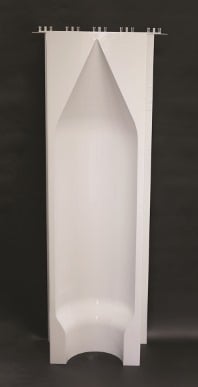 A rocket fairing tool built with the Infinite Built technique. Image source: StratasysThe Robotic Composite demonstrator provides for what may be an enhanced capability to use FDM to make smaller, discrete parts. In particular, says Anderson, it obviates the need for much of the “support structure” that established additive techniques often require to be built into the part as it is fabricated and which later have to be removed. One experimental part required “80% less support” than it would otherwise, he says. One type of part that could benefit from this capability might be one that requires some thin external elements such as fins. Another might be ducting, especially if it has to be made in an undulating shape.
Moreover, Anderson says, this new approach may solve a persistent problem with previous additive fabrication techniques: that the Z-axis of a part could seldom be made as strong as the X and Y axes. “With a robot we can just come back and add reinforcement,” he says.
Manufacturing Applications
The attraction for real potential industrial users is expressed by Teri Finchamp, director of operations and quality for Boeing Phantom Works, the planemaker's prototyping operation. She says that the company has used printed parts since 1997 and began a specific association with Stratasys and its FDM technology in 2003. Use of the technique, she says, is now pervasive as a prototyping tool.
“We have always had a problem with size and making larger fabrications has involved making smaller parts and gluing them together,” she says. The prototype processes may change that, however. “We will have the ability to grow these much larger parts and much quicker.”
 Ellen Lee, Ford MotorAccording to Ellen Lee, technical leader for additive manufacturing research with Ford Motor, the automaker made its first forays into additive techniques three decades ago. The company uses them primarily as a prototyping tool in product development projects and also to fabricate jigs and fixtures that are used in manufacturing operations. In addition, additive manufacturing is seeing limited use to make parts on vehicles. These tend to be “niche applications such as in our racing activities,” she says.
But Lee also says that the technology is effectively at the limits of its usefulness and that the new developments – particularly the Infinite-Build, which Ford and Boeing helped to specify – have the potential to push the boundaries further. “We think this will enable us to get extra function from the technology that we cannot get today,” she says. “It will give us an enhanced ability to integrate and consolidate parts and means that we will be able to design for the function of the application rather than around the limitations of the manufacturing process.”
For now, says Lee, Ford still regards additive techniques as a means of supporting manufacturing by producing jigs and fixtures rather than end-use parts. Even the projected ability of the Infinite-Build process to make fabrications faster than before likely will not make it feasible as a manufacturing tool for volume car production. Instead, she sees the technique as a way to reduce the number of individual parts that some fixturing requires. It also may be used to equipment that can be customized to the capabilities of individual workers, increasing “ergonomic efficiency and ultimately product quality.”
What seems more certain is that the new techniques are sufficiently advanced to overcome some of the barriers to the wider use of additive techniques that currently exist. “We have overcome all the significant technical hurdles involved,” says Anderson, “and are looking to find real applications before the end of this decade.”
Editor's note: Both of the technologies described here were displayed at IMTS in Chicago from Sept. 12-17, 2016.