Bio-Derived Battery Is Long Lasting and High Voltage
John Simpson | August 16, 2016University of Toronto (UT) chemists have created a battery that stores energy in a biologically derived unit, paving the way for cheaper consumer electronics that are easier on the environment.
The battery is similar to many commercially available, high-energy lithium-ion batteries, but with one important difference. It uses flavin from vitamin B2 as the cathode, the part that stores the electricity that is released when connected to a device.
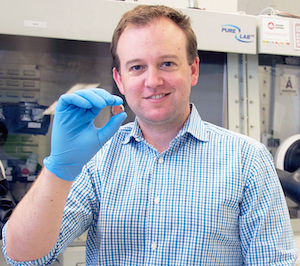 Dwight Seferos, associate professor in the University of Toronto's Department of Chemistry, holds the nickel-sized prototype. Image credit: Diana Tyszko.While bio-derived battery parts have been created previously, the researchers say this is the first system that uses bio-derived polymers—long-chain molecules—for one of the electrodes. Thus, battery energy is essentially stored in a vitamin-created plastic instead of costlier, harder-to-process and more environmentally harmful metals such as cobalt.
“Getting the right material evolved over time and definitely took some test reactions,” says doctoral student Tyler Schon. He and researchers that included Dwight Seferos, associate professor in UT’s Department of Chemistry, happened upon the material while testing a variety of long-chain polymers—specifically pendant group polymers, the molecules attached to a "backbone" chain of a long molecule.
The team created the material from vitamin B2 that originated in genetically modified fungi using a semi-synthetic process to prepare the polymer by linking two flavin units to a long-chain molecule backbone. This allowed for a green battery with high capacity and high voltage—something of growing importance as the Internet of Things increases reliance on battery-powered portable devices.
While the size of the current prototype is on the scale of a hearing-aid battery, the team hopes their breakthrough could lay the groundwork for powerful, thin, flexible and even transparent metal-free batteries that could support the next wave of consumer electronics.