Compostable Closed-Cell Foam Is Created
Riia O’Donnell | July 06, 2016BASF is launching a closed-ell particle foam that the company says is certified compostable. BASF says that its ecovioEA product has mechanical properties similar to EPS, with energy absorption and resilience even when it is subject to multiple impact loads.
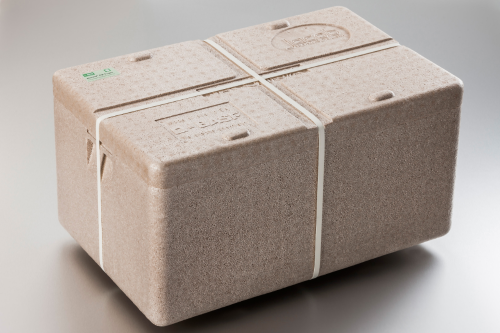 Compostable, expandable particle foam. Image Credit: BASF BASF claims that ecovioEA is one of the first expandable, closed-cell foam materials that is biobased and certified compostable. It is made with the biodegradable polymer ecoflex and polylactic acid (PLA) which is made with corn or other sugar-generating plants such as manioc.
In a manufacturing process, expandable granules are charged with the blowing agent pentane. This allows pre-expansion of the material on conventional EPS pre-expanders as well as subsequent molding. The raw granules have a density of approximately 700g/l. EcovioEA is available in the market with a particle size of 1.05 mm. A 0.8mm grade is under development. Delivered in an octabin, the material can be stored for at least six months without quality degradation, BASF says.
A two-step process allows processors to form the product into almost any shape. First, the granules are pre-expanded with steam to produce closed-cell beads with an adjustable minimum bulk density of 25g/l. A prefoaming time assists with low energy consumption in this step. Second, the expanded granules are processed into molded parts. The processing is done on existing EPS or EPP production machines with no need for conversion.
With the ability to withstand temperatures in excess of 100° C for several hours, the material may be well suited for hot-melt adhesive applications. BASF says that ecovio may find uses for transport packaging of high-value or delicate goods, or where a strong level of impact resistance and robustness is necessary.