Microrobots take over the kitchen: Precision automation for next-gen food processing
Jody Dascalu | May 01, 2026Microrobotics provides a solution for automation tasks where traditional systems fail due to size or lack of delicacy. While standard robotic arms excel at high speed palletizing and bulk sorting, they lack the spatial resolution needed for micrometer level tasks. As global manufacturing demands higher precision, these small scale systems are becoming a primary tool for quality control. By moving beyond fixed-path planning, microrobots allow for a level of control in inspection and the handling of fragile materials that was previously difficult to automate.
The shift toward these responsive environments allows food scientists to automate the detection of trace contaminants and the processing of complex food structures. These systems navigate confined spaces and perform high resolution motion control, which is essential for maintaining safety standards. By integrating these units into the production line, factories can achieve a more granular level of quality assurance. This technology represents a significant evolution in hardware, enabling the positioning of delicate textures and microscopic inspection without the mechanical stress typical of macro scale robotics.
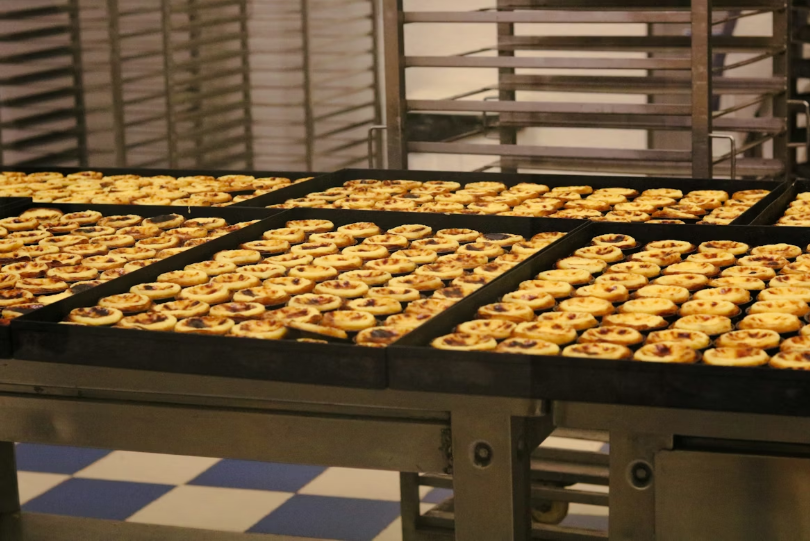 Trays of small baked pastries arranged on a conveyor belt inside a commercial food production facility. Source: Sina Reinartz/Unsplash
Bottlenecks in current automation
Traditional food processing lines rely heavily on conveyor systems combined with machine vision for quality control. These setups are effective for high-volume sorting but struggle when products have irregular shapes or partially hidden surfaces. Fixed cameras frequently miss defects located in shadows or recessed areas, allowing small contaminants or structural inconsistencies to pass through the inspection stage.
Mechanical handling presents another limitation. Industrial robotic arms are designed for strength and throughput rather than delicate interaction. Their positioning accuracy typically operates at the millimeter scale, which can be insufficient for manipulating fragile or miniature food components. Attempting to increase precision within these systems often reduces operational speed, creating a trade-off between throughput and accuracy that constrains process optimization.
Fundamentals of microrobotic systems
Microrobotic systems are characterized by their ability to perform motion and positioning tasks at sub-millimeter resolution. Instead of relying solely on high-torque motors, these platforms often employ actuation methods such as magnetic fields or piezoelectric elements. These mechanisms allow highly controlled motion in environments where larger robotic systems cannot operate effectively.
Such actuation approaches support precise positioning and controlled interaction with small-scale structures. Microrobotic units can move within dense product streams, navigate narrow spaces in molds or processing equipment, and perform detailed contact measurements. This capability allows them to operate directly at the scale of individual surfaces or components within a product.
Automated inspection with microrobotics
Many quality control tasks in food processing require identifying defects or contaminants that are difficult to detect using standard machine vision systems. Microrobotic inspection platforms address this challenge by carrying sensing elements directly to the inspection site. Optical, force or tactile sensors mounted on these platforms can perform localized measurements at micrometer-scale proximity to the product surface.
Because these robots are mobile rather than fixed in place, they can reposition themselves around curved or partially obstructed areas of a product. This mobility enables inspection of regions that are commonly missed in conveyor-based camera systems. When an anomaly is detected during an initial scan, the robot can reposition and collect additional measurements before a final classification is made, improving the reliability of defect identification.
Precise handling and placement
Microrobotic platforms also enable controlled handling of fragile or irregular food components that are difficult to manage using conventional industrial grippers. Through fine force control and tactile feedback, these systems interact with delicate materials such as thin pastries, small decorations or soft emulsions while minimizing mechanical stress and product damage during processing or assembly.
In production environments, microrobots typically operate alongside conventional automation. High-speed conveyors and macro-scale robotic systems continue to manage bulk transport, while microrobotic units perform precision tasks such as placing inclusions, orienting irregular pieces or sorting small components. Because these systems rely on precise motion control rather than fixed tooling, they adapt more easily to variations in product shape and size while maintaining consistent positional accuracy. These systems ensure that product quality remains uniform even in batches with high physical variability.
System integration and control strategies
The practical deployment of microrobotics in food processing requires sophisticated control frameworks to manage high-speed, high-precision tasks. Real-time feedback loops are central to this process, utilizing sensor-based control and adaptive trajectory planning. These loops allow the system to modulate its movements based on immediate environmental data, which is critical for maintaining low-latency communication between the micro-actuators and the broader production line.
Successful implementation often relies on hybrid control architectures. In these configurations, a centralized planning system manages overall throughput while distributed micro-actuators handle localized precision tasks. This division of labor ensures that the microrobots can respond to surface-level variations without slowing down the primary conveyor. Such architectures are designed to maintain high performance even when dealing with the high-frequency vibrations and rapid movement typical of industrial environments.
Safety and redundancy are also prioritized within these control strategies. Systems are programmed with collision avoidance logic to prevent interference in dense processing contexts where multiple robotic units may be operating simultaneously. As micro-actuator technology and control software continue to improve, the feasibility of integrating these units into existing factory infrastructures increases. This ensures that the systems remain robust and reliable under the continuous demands of full-scale manufacturing.
Deployment constraints and future engineering priorities
Although microrobotic systems demonstrate clear advantages in precision inspection and handling, several engineering constraints still limit large-scale deployment in food processing lines. The primary challenge is matching micrometer-level accuracy with industrial throughput. Most microrobotic platforms operate effectively in controlled laboratory environments, but maintaining positional accuracy while operating at conveyor speeds typical of commercial food processing remains an active area of development.
Environmental durability also plays a major role in system feasibility. Food processing environments expose equipment to moisture, particulates, vibration and aggressive cleaning cycles. Sensors, micro-actuators and embedded electronics must maintain calibration and mechanical stability under these conditions while remaining compliant with food-safe material standards.
Future development is therefore likely to focus on ruggedized actuator designs, standardized communication interfaces and modular integration with existing automation infrastructure. Microrobotic units are expected to appear as specialized precision modules inserted at critical inspection or handling points within otherwise conventional production lines.