Electricity Gives Jolt to Green Chemistry
Engineering360 News Desk | July 01, 2016A safer, greener and cheaper way to achieve a chemical reaction commonly used in the pharmaceutical, flavor and fragrance industries could be just an electrical zap away.
Scientists at The Scripps Research Institute, TSRI, and pharmaceutical chemists at Bristol-Myers Squibb and Asymchem Life Science of China have developed an easily scalable method to achieve allylic oxidation that uses only inexpensive, safe chemicals and good, old-fashioned electrochemistry—driving a reaction with an electric current.
Researchers demonstrated the value of the new technique by using it to make more than 40 sought-after compounds more cheaply, cleanly and more scalable than provided by existing methods. “The scope of the reaction is just phenomenal; it’s super easy to do, and the overall improvement in environmental sustainability is dramatic,” said principal investigator Phil Baran, professor of chemistry at TSRI.
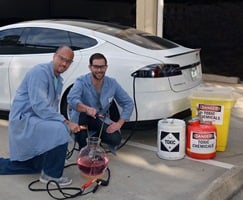 Scripps Research Institute chemists Phil Baran (left) and Evan Horn pose in front of an electric car, whose principles of sustainable transport pertain to the sustainable chemistry. Source: The Scripps Research InstituteAs explained by researchers, allylic oxidation reactions essentially attach an oxygen to a carbon within a cluster of atoms called an allyl group—a common feature on organic molecules. The addition of that one oxygen atom can bring about a major change in the properties of the overall molecule, and thus allylic oxidation is used throughout chemistry to improve the properties of an existing compound or to enable the synthesis of a compound otherwise obtainable only from plants.
Typically, allylic oxidation reactions use reagents that are either toxic or expensive, or both, and thus have been largely restricted to small-scale applications. TSRI researchers set out to find a cheaper and greener way to perform allylic oxidations so they could be useful on a larger scale.
What the research team developed was a new electrochemistry-based method in which all the reagents and other setup details are relatively simple, inexpensive and sustainable. The electrodes used to transmit current through the reaction vessel are made of vitreous carbon and cost just a few dollars each. The oxygen source is not pure O2 gas, which can create a fire or explosion hazard, but a widely available liquid oxidant, tert-butyl hydroperoxide.
Researchers demonstrated the new method by employing allylic oxidations to modify several compounds of interest to Bristol-Myers Squibb and on more than a dozen compounds broadly known as terpenes. In nearly all of the demonstrations, the new method resulted in better yields and safer and cheaper reagents than prior methods, researchers said.
Further research is ongoing to develop electrochemistry-based methods for reactions beyond allylic oxidation.