Reusable Photocurable Liquid Could Have PCB, 3D-Printing Applications
John Simpson | June 10, 2016Researchers at Kobe University and the Tokyo University of Science have developed a metal-containing compound that transforms into a solid when exposed to light and returns to liquid form when heated. The substance could potentially be used for photolithography technology, such as fabricating printed circuits, among other applications.
Coordination polymers are solids with various useful applications. In recent years, research into coordination polymers has increased, and scientists have developed many ways to synthesize them, but most of these methods rely on chemical reactions in solutions. According to the researchers, this is the first example of a method that creates coordination polymers by exposing liquids to light.
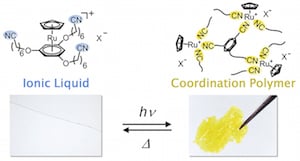 The chemical structure (above) and appearance (beneath) of the ionic liquid and coordination polymer. Image credit: Kobe University. Techniques that can control the properties of materials through external stimuli such as light and heat are extremely important in creating materials for use in electronics. For example, materials that solidify when exposed to light (photosensitive resins) are used in creating printed circuits, but it is difficult to reuse these materials.
Kobe University Professor Mochida Tomoyuki's research group proposed that if they could control the binding process between metal ions and organic molecules using heat and light, they could create a material whose properties change dramatically after being exposed to external stimuli. The group developed an ionic liquid from a ruthenium complex with cyano groups that is colorless, clear, non-volatile and does not freeze even at -50 degrees Celsius. If ultraviolet light is applied to the liquid for several hours, it changes into an amorphous coordination polymer, which if heated for one minute at 130 degrees Celsius returns to its original ionic liquid form.
By applying light and heat, the group realized a reversible transformation between an ionic liquid and a solid coordination polymer—two substances with completely different structures and chemical properties. In addition to printed circuits, such technology could potentially be useful in 3D printing and adhesives.
“We plan to continue research on the molecular design of this substance to reduce its response time and look into creating more functions for this coordination polymer,” says Tomoyuki.