Reversible Coordination Polymers Are Created
Riia O’Donnell | June 06, 2016A research team from Kobe University Graduate School of Science and Tokyo University of Science, Yamaguchi has created a metal-containing compound that changes into a solid when exposed to light, and then returns to liquid form if heated.
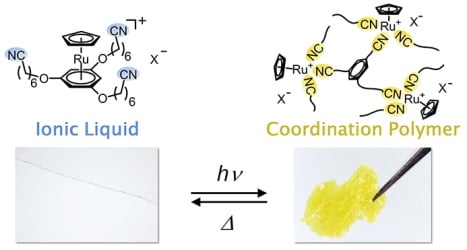 New solid material reverts to liquid when heated. Image source: Kobe University Graduate School of Science Today’s coordination polymers typically rely on chemical reactions in solutions. The new compound creates coordination polymers by exposing the liquids to light. The ability to control materials as they are exposed to external stimuli such as heat and light is valuable in creating electronics.
However, it has been difficult to reuse photosensitive resins, for example, that are used in creating printed circuits. The new material represents a reversible transformation between an ionic liquid and a solid coordination polymer: these two substances hold different structures and different chemical properties.
By controlling the binding process between metal ions and organic molecules with heat and light, the research team created a material that changes its properties when exposed to external stimuli. The non-volatile liquid is colorless, clear and doesn’t freeze even at temperatures below -50 C. A few hours of exposure to ultraviolet light changes it to an amorphous coordination polymer. When heated for 60 seconds at 130 C it returns it to its original ionic liquid form. The research team says the reusable photocurable liquid could be applied to printed circuit boards, 3D printing and adhesives, among other applications.