Prototyping System Allows Design Revisions During 3D Printing
John Simpson | June 09, 2016Cornell researchers have come up with an interactive prototyping system that 3D prints an object while it is being designed; the process can be paused at any time to test, measure and, if necessary, make changes that will be added to the physical model still in the printer.
“We are going from human-computer interaction to human-machine interaction,” says graduate student Huaishu Peng, who described the On-the-Fly-Print system in a paper presented at the Association for Computing Machinery's 2016 Conference for Human-Computer Interaction. Co-authors are François Guimbretière, associate professor of information science; Steve Marschner, professor of computer science; and doctoral student Rundong Wu.
Their system uses a version of a “WirePrint” printer developed in a collaboration between Guimbretière’s lab and the Hasso Platner Institute, in Potsdam, Germany.
In conventional 3D printing, a nozzle scans across a stage depositing drops of plastic, rising slightly after each pass to build an object in a series of layers. With the WirePrint technique, the nozzle extrudes a rope of quick-hardening plastic to create a wire frame that represents the surface of the solid object described in a computer-aided design (CAD) file. WirePrint aims to speed prototyping by creating a model of the shape of an object instead of printing the entire solid. The On-the-Fly-Print system builds on that idea by allowing the designer to make refinements while printing is in progress.
According to its developers, their printer has “five degrees of freedom.” While its nozzle can only operate vertically, the printer’s stage can be rotated to present any of a model's planes face up. An airplane fuselage, for example, can be turned on its side to add a wing. There is also a cutter to remove parts of the model, to give the airplane a cockpit, for example. A video further describing the process can be viewed here.
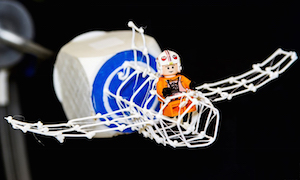 This wire frame prototype of a toy aircraft was printed in just 10 minutes. Image credit: Cornell University.The nozzle has been extended so it can reach through the wire mesh to make changes inside. A removable base aligned by magnets allows the operator to take the model out of the printer to measure or test to see if it fits where it is supposed to go, then replace it in the precise original location to resume printing.
The software—a plug-in to a popular CAD program—designs the wire frame and sends instructions to the printer, allowing for interruptions. The designer can concentrate on the digital model and let the software control the printer. Printing can continue while the designer works on the CAD file but will resume when that work is done, incorporating the changes into the print.
As a demonstration, the researchers created a model for a toy airplane to fit into a Lego airport set. This required adding wings, cutting out a cockpit for a Lego pilot and frequently removing the model to see if the wingspan would fit on the runway. The entire project was completed in just 10 minutes.
By creating a “low-fidelity sketch” of what the finished product will look like and allowing the designer to redraw it as it develops, the researchers say, the approach has the potential to improve the overall quality of the design process.