3D Printer Acoustics Could Offer Gateway for Thieves
Engineering360 News Desk | March 14, 2016Researchers at the University of California’s Irvine campus have found that 3D printing processes may be stolen with little more than a smartphone. With hours spent on creating proprietary design and intellectual property, the G-code, or source file for any 3D printed object is generally highly encrypted to protect it from cyber thieves. But the printing process itself may be a back door to reveal the code simply by recording the sounds a printer makes when creating an object.
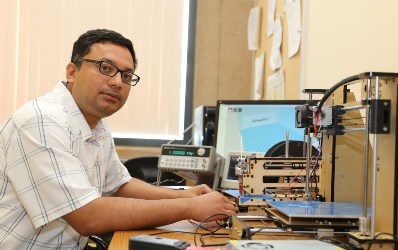 Mohammad al Faruque led the discovery of potential 3D security breaches via acoustics.The study reveals that by recording the sounds made by a printer, an object may be reverse-engineered by mimicking the acoustical sounds the printer makes. The team, headed by Mohammad al Faruque, UCI’s Advanced Integrated Cyber-Physical Systems Lab director, showed 90 percent accuracy in a laboratory environment in duplicating a key-shaped object using the sound copying process.
By placing an ordinary phone next to the printer, the recordings capture the acoustical sounds that execute the movements of the printer nozzle. These sounds allowed the research team to reverse engineer the object and recreate it in their own lab.
The team made the discovery by accident, while working on the relationship between information and energy flows: they noted that while some energy is useful and used, other energy becomes emissions, which hold information that might be unintentionally disclosed. The emissions, or acoustical sounds, created by a 3D printer hold all the information needed to replicate the work.
Although the researchers initially weren’t interested in the potential security breach, they soon realized that the finding was highly relevant. In addition to interest from other departments within the university, they have seen interest in the research from various government agencies.
To overcome the problem, companies might ban smartphones and recording devices where printers are used, or jam the acoustics with white-noise devices.