Shrimp Club Inspires Super Strong Composites
Riia O’Donnell | June 06, 2016University of California – Riverside researchers used the mantis shrimp as inspiration for strong composite materials.
Researchers noted that the shrimp crushes the shell of its prey using a dactyl club. The club has a herringbone structure that combines an “impact region,” a shock-absorbing layer and an outer surface with a thin, particle-like coating that acts to delocalize stress. The structure allows the shrimp to inflict significant damage on its prey with speed and force, achieving an acceleration of 10,000g yet sustaining no damage.
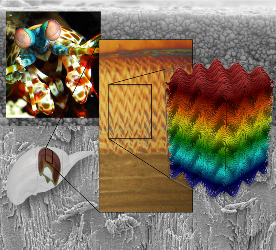 Herringbone structure found in the impact region of the mantis shrimp's dactyl club. Image source: University of California Riverside The team speculates that the difference in stresses during the formation of the impact region’s crystalline material causes the helicoidal arrangement to buckle. The researchers can view this using high-power microscopy of the herringbone pattern.
Working with a team from Purdue University, the Riverside researchers fabricated the structure with a 3D printer. Their computational models showed that damaging stress to the structure was more uniformly distributed, mitigating catastrophic failure.
Compression tests showed the herringbone structure makes the impact region more effective than the periodic region in redistributing stress and deflecting cracks. The team is creating composites that use the energy-absorbing component as well as the stiff outer layer inspired from the mantis. The material could be used for a variety of applications, including aerospace, automotive and body armor.