Research Team Develops Synthetic Opal Material
Riia O’Donnell | June 06, 2016A team from Cambridge University’s Cavendish Laboratories and Germany’s DKI (Deutsches Kunststoff-Institut) has created industrially scalable structural color materials that could find uses in decorative, security and sensor applications.
The team used chemistry that is similar to that of latex paint production to create a mass of spheres that are nearly identical, which are synthesized with a hard, central core of crosslinked polystyrene. They then bind them to a soft outer shell of polyethylene acrylate.
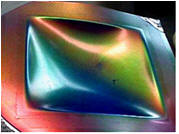 Chewing-gum consistency material changes colors. Image source: Cambridge University The resulting material has the consistency of chewing gum. When stretched, the material changes color in a predictable manner: the faster and longer it’s stretched, the more varied the change of color. Even when stretched in a different direction, the color will change differently. When returned to its original state, the material becomes its initial coloration.
For decorative applications, the material appears metallic although it contains no metals. It also changes color depending on the viewer’s angle. It is also resistant to fading, contains no UV sensitive dyes, and has low toxicity. It can be made with common polymers and silica.
The material is similar to opals, which in nature achieve their structure by regular stacking of round glass spheres. Similarly, polymer opals also have ordered spheres. When these spheres are subjected to shearing forces of around 150 C, they self-assemble into an ordered 3D crystal that displays structural color. The soft shells of adjacent particles deform and blend into a continuous matrix. Meanwhile, central cores are ordered in a regular pattern that diffracts incoming light. The size of the particles controls the color of the opals.