"Liquid Wire" Inspired by Spider Webs
John Simpson | June 03, 2016Pulling on a sticky thread in a spider web and letting it snap back reveals that the thread always stays taut—this is because any loose thread is immediately spooled inside the tiny droplets of watery glue that coat and surround the gossamer fibers of the web's capture spiral.
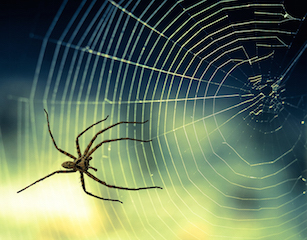 Droplets of glue in spider silk help reel in loose bits of thread to keep the web tight at all times. Image credit: Pixabay.Now researchers from the University of Oxford, UK and the Université Pierre et Marie Curie, Paris have created composite fibers in the laboratory that extend like a solid and compress like a liquid, just like the spider's capture silk. The development could lead to new bioinspired technologies, the researchers say.
"The thousands of tiny droplets of glue that cover the capture spiral of the spider's orb web do much more than make the silk sticky and catch the fly," says Professor Fritz Vollrath, of Oxford's Department of Zoology. "Surprisingly, each drop packs enough punch in its watery skins to reel in loose bits of thread. And this winching behavior is used to excellent effect to keep the threads tight at all times, as we can all observe and test in the webs in our gardens."
The team was able to recreate this effect in the laboratory using oil droplets on a plastic filament. The artificial system behaved just like the spider’s natural winch silk, with spools of filament reeling and unreeling inside the oil droplets as the thread extended and contracted (see video here).
"Our bio-inspired hybrid threads could be manufactured from virtually any components," comments Dr. Hervé Elettro, doctoral researcher at Université Pierre et Marie Curie. "These new insights could lead to a wide range of applications, such as microfabrication of complex structures, reversible micro-motors or self-tensioned stretchable systems."