Removing the Risk from Robot-Human Interactions
Engineering360 News Desk | June 02, 2016A soft actuator using electrically controllable membranes could pave the way for robots that are no danger to humans.
Robots with soft actuators are typically tethered by pneumatic hoses, restricting their radius of motion. Researchers at the Max Planck Institute for Intelligent Systems, in Stuttgart, have now developed an actuator that can be controlled by means of an electric field rather than pumps and compressors.
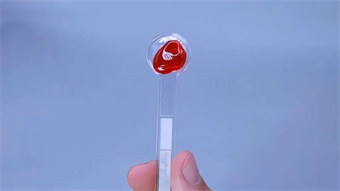
The new device consists of a dielectric elastomer actuator: a membrane made of hyperelastic material similar to a latex balloon with flexible electrodes attached to each side. The stretching of the membrane is regulated by means of an electric field between the electrodes, as the electrodes attract each other and squeeze the membrane when voltage is applied. By attaching multiple such membranes, the place of deformation can be shifted controllably in the system.
 Membranes surrounding sealed, air-filled chambers can be used as actuators, facilitating risk-free contact between humans and robots. Image credit: ©Alejandro Posada.The researchers were helped by the fact that their membrane material has two stable states, i.e., it can have two different volume configurations at a given pressure without the need to minimize the larger volume. This is akin to letting the air out of an inflated balloon; it does not shrink back to its original size, but remains significantly larger.
Thanks to this bi-stable state, the researchers are able to move air between a more-inflated chamber and a less-inflated one. They do this by applying an electric current to the membrane of the smaller chamber, which responds by stretching and sucking air out of the other bubble. When the power supply is switched off, the membrane contracts, but not to its original volume; it remains larger, corresponding to its stretched state.
“It is important to find suitable hyperelastic polymers that will enable strong and fast deformation and be durable,” says Dr. Metin Sitti, director. With this in mind, the team has tested different membrane materials and also used models to systematically record the behavior of the elastomer in the actuator.
Thus far, the elastomers tested by Sitti’s team have each had a mix of advantages and disadvantages. Some show strong deformation, but at a slow rate. Others work fast, but their deformation is more limited.
“We will combine different materials with a view to combining different properties in a single membrane,” says Sitti. They also plan to integrate their actuator in a robot so that it can, for instance, move its legs but still give way if it happens to come across a human.