Taking 3D Printing to Air
Riia O'Donnell | May 25, 2016A team from Harvard University’s Wyss Institute for Biologically Inspired Engineering and John A. Paulson School of Engineering and Applied Sciences (SEAS) has developed a technique to 3D print and laser anneal conductive metallic inks without any supports. The approach may offer a means to create customized biomedical and electronic devices that don’t rely on a rigid substrate or a flat plane to develop.
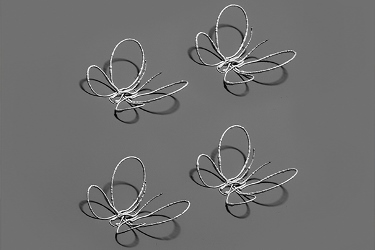 3D butterflies printed without a support structure. Credit: Lewis Lab / Wyss Institute at Harvard University. The technique uses an ink made with silver nanoparticles that is sent through a 3D printer’s nozzle, and then is immediately annealed using a laser that solidifies the ink mid-air. The nozzle moves along three axes and is combined with a rotary print stage for freeform curvature. The researchers say the printed wires show excellent electrical conductivity, nearly matching bulk silver.
The laser-assisted direct ink writing is said to be capable of creating complex architectures, and the laser heating enables the user to print electrically conductive silver wires directly on to plastic substrates. The research team believes the method will not only produce curves and spirals, but also sharp angles, turns, and directional changes. The technique may open the door to applications in electronic and biomedical devices that depend on customized metallic architectures.