Daffodils Inspire Design of Stable Structures
Engineering360 News Desk | May 24, 2016Researchers from Seoul National University and Ajou University, in South Korea, have found that a structure with a twisted, helical shape and an elliptical cross section—like those of the stem of a daffodil—can reduce drag and eliminate side-force fluctuations.
Side forces come into play whenever wind flows across an elongated object—as when an arm is projected out the side of a moving car. As the air flows around the arm, it forms vortices that come off the top and bottom of the arm in an alternating fashion. This vortex shedding, as it is called, imparts periodic forces on the arm.
"You will immediately feel that your arm will be forced to move up and down," says Haecheon Choi, professor in Seoul National University's School of Mechanical and Aerospace Engineering.
This phenomenon affects any elongated structure caught in wind or water currents, such as lampposts, high rises and the long vertical pipes used for drilling oil at sea. In the case of the Tacoma Narrows Bridge, which twisted in the wind before it snapped and plunged into the water below just months after opening in 1940, the frequency of these periodic forces happened to hit its resonant frequency.
"This vortex shedding triggered the twisting mode of the bridge," Choi says, "and finally the bridge collapsed."
To find a way to reduce these forces, the researchers looked to nature for inspiration. Specifically, they studied the shape of a daffodil stem, whose twisting, lemon-shaped cross-section enables it to turn away from wind and protect its petals.
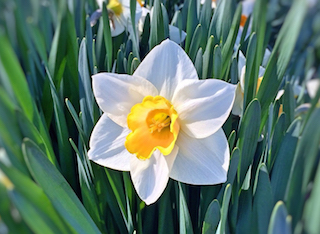 The geometry of the daffodil stem could inform the design of more stable antennae, lampposts and chimneys. Image credit: Pixabay.The researchers used computer simulations to explore the fluid dynamics around the daffodil stem's shape: a helically twisted, elliptical cylinder. They tested different variations—some with more elliptical cross-sections or with more twists, for example—in smooth, laminar airflow and in more turbulent wind. In both cases, the daffodil shape made a big difference.
"Some helically twisted cylinders annihilated the vortex shedding, resulting in drag reduction and zero side-force fluctuations," Choi says. Compared to a round cylinder, the daffodil shape reduced drag by 18% and 23% for laminar and turbulent flows, respectively.
The unique geometry of the daffodil stem could be used to design more stable structures. Although such a shape probably doesn't make sense for a bridge, it could work for things such as antennae, lampposts, chimneys, underwater oil-drilling pipes, skyscrapers and even golf clubs. In fact, Choi says, the researchers already have a patent for a helical golf club.