Drones to Begin Ferrying Blood Supplies in Rwanda
Engineering360 News Desk | April 22, 2016This summer, a fleet of drones will begin carrying blood products for 20 hospitals and health centers to service residents in remote areas of Rwanda.
The service is being made possible via a partnership between the government of Rwanda and San Francisco-based startup Zipline, which designs, tests and builds the drones.
"This is going to be the first time in the history of human civilization that autonomous or self-driving vehicles will be used to deliver medical products," said Zipline CEO Keller Rinaudo, after signing a memorandum of understanding with the Rwandan government establishing the arrangement in February. "It will be the first time ever that these vehicles are actually integrated into an existing public health supply chain."
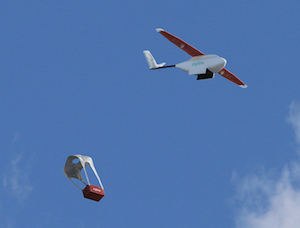 "Zips" fly at a speed of 100 km/h—much faster than is achievable via land transport in Rwanda. Image credit: Zipline.According to Zipline, more than two billion people worldwide lack adequate access to essential medical products, often due to challenging terrain and gaps in infrastructure. Because of this, over 2.9 million children under age five die every year, the company says. Up to 150,000 pregnancy-related deaths could be avoided each year if mothers had reliable access to safe blood.
Zipline's battery-powered unmanned aerial vehicles (UAVs) weigh 10 kg, use fixed wings with a 1.5 m span and can carry two pints of blood. They fly at a maximum height of 125 m and at a speed of 100 km/h—significantly faster than could be achieved via land transportation.
Health workers can place an order by text message. Within minutes, a "Zip," as the UAVs are known, is prepared and launched into the sky. The medical products—which in addition to blood could include vaccines or medicine—are then dropped off, landing at the health facility in an open area the size of a few parking spaces.
Zipline says that it expects to use its drone technology to begin delivering medical products in other countries later this year.