AI model simulates substance behavior
Chris Vavra | November 09, 2026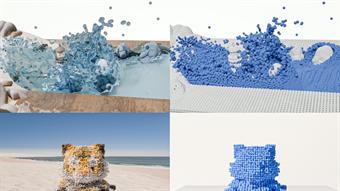 Courtesy: Massachusetts Institute of Technology (MIT)
Researchers at MIT, the University of British Columbia (UBC) and elsewhere have developed a single deep-learning system, called WorldParticle, that could help engineers model different physical phenomena, from sliding sand to folding proteins, with one unified artificial intelligence architecture.
This system can model processes that typically require separate simulators, such as a fluid sloshing against a deformable solid. For example, it could help engineers study where and how granular materials, like sand or soil, could move when a soft robot touches them.
Because the model learns the underlying dynamics rather than being programmed with an equation, it can adapt to elements that weren’t encountered during training.
In the long term, the researchers hope this work helps scientists discover new materials and explore physical processes they would be unable to effectively study with existing simulation methods. The general-purpose framework could be applied to many materials and processes, including soft robot manipulation tasks, RNA evolution and more.
Developing a unified simulation
The researchers drew inspiration from world models. These AI systems learn the rules that govern the physical world so they can predict how objects or environments will change over time in response to certain actions or conditions.
The researchers applied these concepts to develop a unified AI architecture that can simulate multiple types of physical phenomena.
WorldParticle breaks an object into thousands or millions of tiny, three-dimensional dots, or particles, using what is known as a Lagrangian representation. It tracks the movement and velocity of the particles over space and time to simulate the material’s dynamics.
In most cases, researchers use a governing equation that defines the fundamental laws which control how that material behaves over time and space.
Instead, the researchers designed a neural network that learns to solve governing equations in general, eliminating the need to design a new model and solver to handle each one.
Once WorldParticle converts an object into particles, a neural network takes the 3D positions and physical properties of the particles as inputs. It outputs their positions and properties for the next frame of the simulation, predicting the material’s motion over time and space in one-second increments.
To streamline processing, the researchers employed a merging technique to combine and compress particles while still allowing WorldParticle to capture fine-grained details of their behavior.