Pack Expo exhibitors spotlight AI, flexible motion, and workforce skills
Chris Vavra | October 27, 2026
Packaging and processing equipment suppliers at Pack Expo focused less on standalone hardware and more on how machines, data and people work together on the plant floor. Interviews on the show floor often turned toward one of four themes:
- AI as a troubleshooting partner
- The value of clean and contextualized data
- Modular motion that adapts to tight spaces and changing products
- The need to build workforce skills.
For engineers, each technology aims to shorten the time between spotting a problem and fixing it.
AI agents take on troubleshooting
Beckhoff demonstrated an AI agent for its TwinCAT automation software, which draws on a knowledge base to resolve common maintenance problems. Marketing communications manager Shane Novacek said Beckhoff designed the agent to work with whichever AI model customers prefer. He noted that many companies offer only one AI option, “so we opened it up.”
Casey Taylor, software product manager for Beckhoff, said the agent helps someone taking over a line who lacks context on the problems they encounter. The more detail a user supplies, the better the answer. In complex situations, the agent recommends solutions and an engineer makes the final decision. For simpler processes, the AI makes decisions within predefined parameters.
“We let it build, find, fix errors and loop around without me answering questions,” Taylor said.
Rockwell Automation pursues a similar goal with Plex, its cloud-based manufacturing execution system (MES). Enterprise software sales executive Joe Loridas said customer feedback pushed the company to prioritize resiliency, and Plex Resilience targets reductions in downtime and maintenance. Rockwell also is investing in AI for its connected worker suite to support employees in their daily tasks.
“If the worker has a question, the AI can provide a standard response, but it can get more specific,” Loridas said.
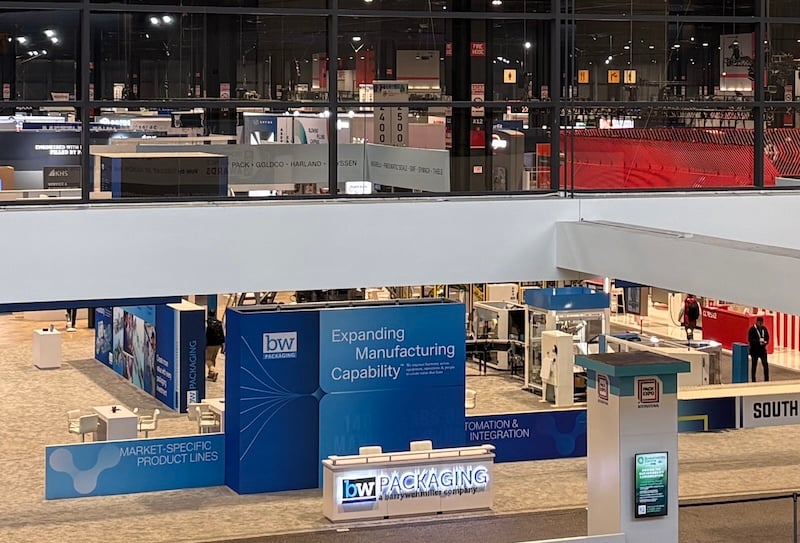 Pack Expo at McCormick Place highlighted many solutions for the packaging, processing and material handling industries. Courtesy: Chris Vavra
Better data produces better answers
AI output quality depends on the data behind it. SmartSights, which acquired Sage Clarity two years ago, showed ABLE, an operational intelligence platform that connects to controllers without custom code and turns raw data into downtime metrics and contextualized digital twins.
Marc Bertrand, director of industry solutions at SmartSights, said ABLE gives workers a single place to drill into the causes of lost performance, which matters because many operators lack training in data analysis. The platform’s topology-aligned, temporally aware digital twin lets AI understand how machines interact, identify equipment running out of balance and suggest corrections.
“It theorizes the scenario based on available data,” Bertrand said, adding that more context and cleaner data produce better answers.
SICK approached the problem from the vision side. Kevin Welsch demonstrated the sensingCam, an industrial streaming and event-recording camera that works like a machine dashcam, capturing live video, high-resolution snapshots and footage before and after an event. Paired with AI tracker software, the system counted and classified products by tags and size and the camera operates in harsh conditions.
Motion systems built for flexibility
Several exhibitors showed motion platforms that simplify machine layouts. Beckhoff’s XPlanar uses energized coils in stationary tiles to levitate passive magnetic movers, which eliminates friction wear and keeps contaminants from spreading through the system.
Brandon Snell presented Beckhoff’s MX-System, which is a cabinet-free design that eliminates extra wiring and integrates with traditional components. Snell said the design draws on 40 years of conversations with machine builders about their pain points.
Festo’s Sandro Quintero introduced the Simplified Motion Series, an integrated motor with an embedded drive. It includes safe torque off (STO) and scales up as needs change. “It’s assigned for simple tasks,” he said.
Festo and CODI Manufacturing also showed the FlexStack Pro, a compact Cartesian gantry palletizer and depalletizer built on Festo’s FPaKit multi-axis handling system. It handles payloads up to 110 pounds at 4 to 10 boxes per minute, which is monitored by Festo’s CEPE.
“We’re using that to show live data on voltage, current and the system’s overall status,” Quintero said.
Regal Rexnord highlighted its Essentials Motion System for multi-axis applications that require adjustable speed and frequency.
Sustainability, worker skills remain priorities
Regal Rexnord also showed high-speed conveying belts designed with recyclability in mind. “Sustainability is becoming very important to our customers,” said Kyle Cayemberg, senior product manager at Regal Rexnord.
Workforce development drew attention as well. Graham Celine said Festo Didactic has invested in technology training for 50 years, working with schools, degree programs and industrial customers.
The program teaches what individual components do before showing how they operate as a unit. Celine noted that even experienced technicians struggle when they miss the bigger picture.
 Festo Didactic provides technicians and students a hands-on approach to product learning. Courtesy: Chris Vavra
“While they can perform tasks, they often don’t know how the system work, so we build them up,” Celine said, noting companies often do a series of training in multiple disciplines to improve their workers’ skill set.
AI agents can shoulder routine diagnosis, but engineers still set the parameters and review complex decisions. Data quality becomes an engineering responsibility because clean, contextualized information determines whether AI suggestions hold up.
Modular motion and digital design tools shorten machine development, while structured training helps new and veteran staff understand how complete systems behave.