Impact of temperature on buffer performance and stability
Dr. Kajal Jaiswal, courtesy of Mettler Toledo | August 27, 2026 Precise pH calibration requires not only high-quality buffer solutions but also careful temperature correction, applied either through automated systems or manual input.
Buffers play a critical role in various scientific, industrial and biological processes by maintaining a stable pH environment despite the addition of acids or bases. However, the performance of buffer solutions and their pH stability can be significantly influenced by temperature. Understanding how temperature affects buffer systems is essential for optimizing experimental conditions, industrial processes and biological applications.
Understanding buffers and pH stability
A buffer solution is typically composed of a weak acid and its conjugate base, or a weak base and its conjugate acid. These components work together to minimize changes in pH when small amounts of acidic or basic substances are introduced. The capacity of a buffer to resist pH changes is known as its buffering capacity.
The pH of these solutions is influenced by the balance between the acid and base components, and this balance is described by the Henderson-Hasselbalch equation, which may sound complex but is essentially a way to predict pH from the components of the buffer.
where is the acid dissociation constant, is the concentration of the conjugate base, and is the concentration of the weak acid.
Temperature’s effect on buffer systems
Temperature influences both the chemical equilibria and the physical properties of solutions. Specifically, it impacts the value of the weak acid/base components of the buffer, which in turn alters the pH.
- Shift in values: The acid dissociation constant is temperature-dependent. Generally, as the temperature increases, the value decreases for most weak acids, meaning they dissociate more at higher temperatures. This shift can cause the buffer’s pH to change even if the ratio of acid to base remains constant.
- Buffer capacity variation: The maximum buffering capacity occurs when the pH is close to the of the buffering agent. Temperature-induced changes in can move the working pH away from the optimal buffering range, reducing buffer effectiveness.
- Faster and slower reactions: Temperature affects reaction rates, potentially changing the speed at which equilibrium is reached in buffer systems. While this does not alter the final pH, it can influence how quickly a system stabilizes after disturbance.
Practical Implications in various fields
- Biological systems: Many enzymes and biochemical reactions depend on tightly regulated pH. Temperature fluctuations can alter buffer pH, affecting enzyme activity and stability, which can lead to variations in metabolic processes.
- Industrial applications: In pharmaceutical manufacturing, chemical syntheses, and food processing, precise pH control is essential. Temperature changes in reactors or storage can impact buffer performance, potentially compromising product quality.
- Analytical chemistry: Accurate pH measurements often require temperature compensation. Buffer solutions used for calibration must have well-characterised temperature-dependent pH values to ensure reliable results.
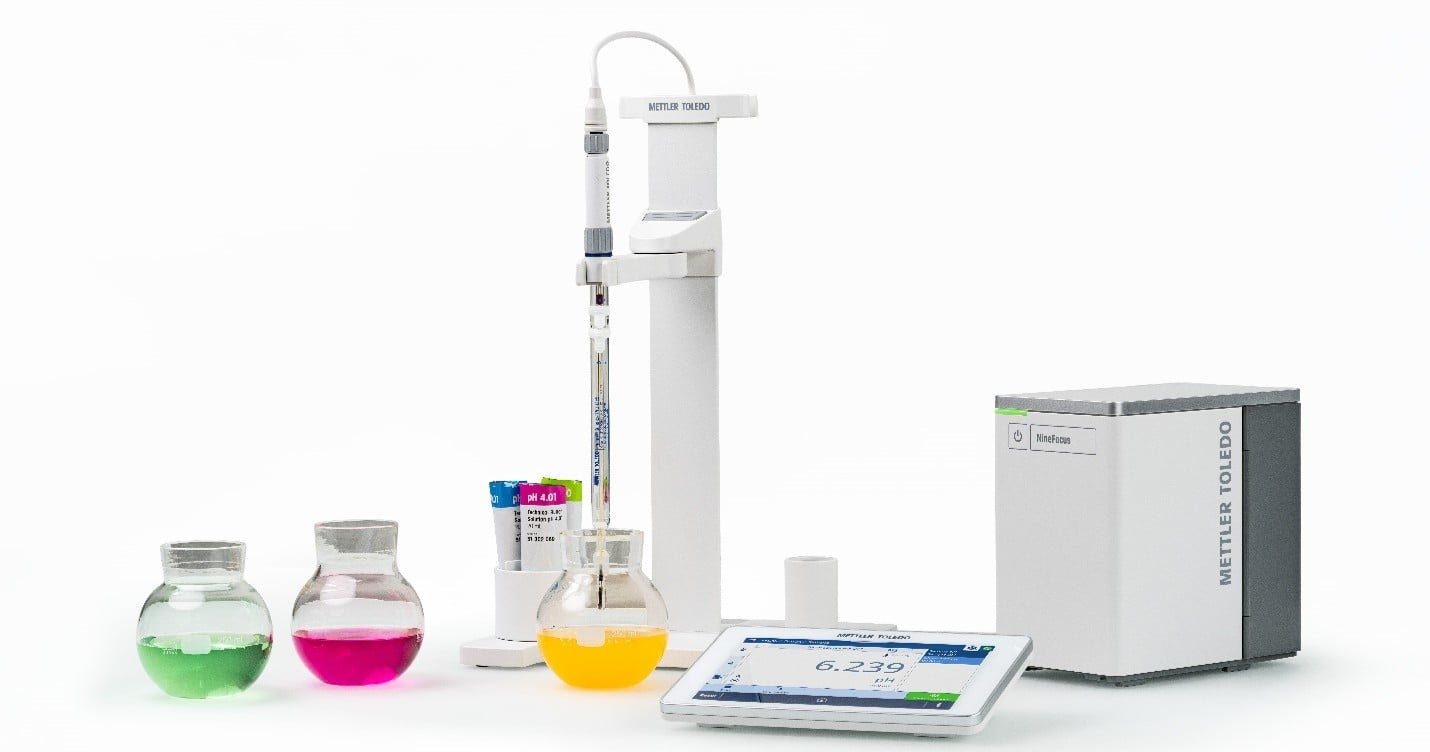 pH measurement of paint solution featuring a pH sensor with integrated temperature control for accurate results.
Mitigating temperature effects on buffers
- Temperature compensation: Mettler Toledo offers temperature-compensated laboratory pH sensors, benchtop pH meters, and calibration buffers that can be employed to maintain accuracy.
- Buffer selection: Choosing buffers with minimal temperature-dependent shifts can enhance stability across a range of temperatures.
- Environmental control: Conducting experiments and processes in temperature-controlled environments minimises variability.
- Buffer concentration adjustment: Increasing buffer concentration can enhance buffering capacity, somewhat offsetting the effects of temperature-induced changes.
Temperature exerts a significant influence on the performance of buffer solutions and their ability to maintain pH stability. By affecting the acid dissociation constants and the chemical equilibria, temperature changes can lead to shifts in pH and reduced buffering capacity. Awareness of these effects and appropriate compensation strategies is crucial for ensuring reliable and reproducible outcomes in scientific research, industrial processes, and biological systems. Selecting suitable buffers, calibrating pH measurements carefully, and controlling environmental conditions are key steps in managing the impact of temperature on buffer performance.
For an in-depth understanding of pH measurement techniques, feel free to download our comprehensive pH theory guide. If you're interested in best practices for handling buffer solutions, our interactive guide is available for download as well.