Beer-making could help sand filters trap harmful bacteria
Marie Donlon | September 08, 2026A byproduct of beer-making has reportedly improved sand’s ability to retain Escherichia coli (E. coli), signaling a possible new application for brewing waste in the water filtration and groundwater protection arenas.
According to the team from the University of Patras in Greece, the biochar is produced from spent malt rootlets, a residual material generated during malt production.
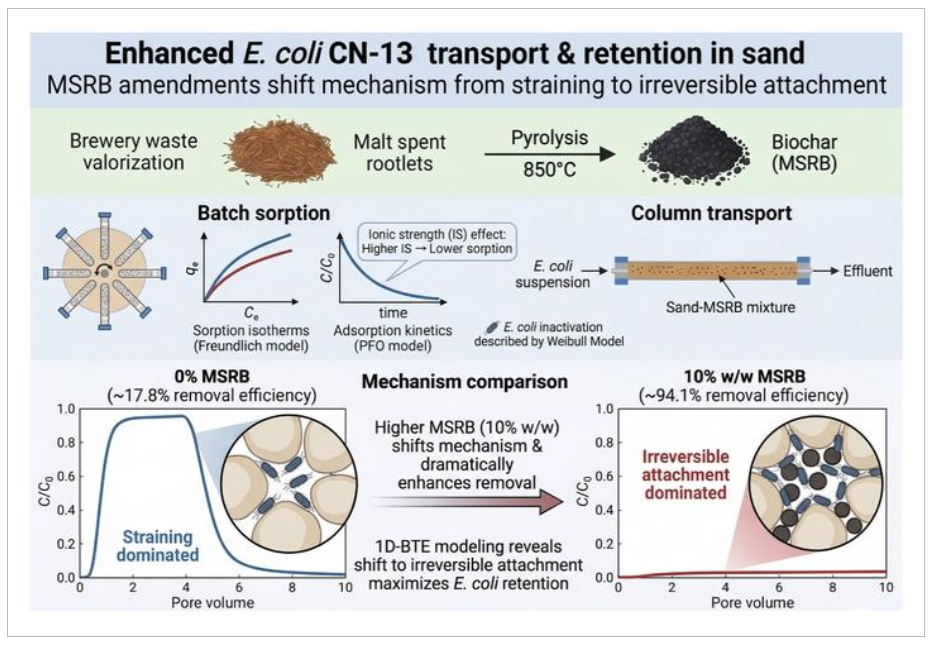 Source: Christos P. Giannopoulos, Christos A. Kolotouros and Ioannis D. Manariotis
In the lab, the team performed a series of column experiments wherein sand modified with 10% biochar removed roughly 94% of E. coli versus the 17.8% removed using untreated sand. The team also discovered that the addition of biochar impacted how bacteria were retained, thereby shifting the process from physical trapping to direct attachment to its surface.
The malt spent rootlets biochar (MSRB) material was developed when the team converted the rootlets into biochar via pyrolysis at 850° C. The resulting material features a highly porous and heterogeneous surface with a surface area of roughly 290 m2/g.
The team determined that the effectiveness of biochar retaining bacteria relied on its concentration as well as the surrounding water chemistry. Further, higher concentrations of biochar shifted the dominant retention mechanism from physical trapping to direct, irreversible attachment of bacteria to the biochar surface.
Although the experiments were performed under controlled lab conditions and additional testing in realistic soils and groundwater is needed, the team suggests that the findings offer proof-of-concept evidence that malt spent rootlets could be turned from an industrial residue into a valuable biochar amendment for sand filtration and sandy agricultural soils.
An article detailing the findings, “Sorption and transport of Escherichia coli CN-13 in saturated sand columns amended with biochar derived from malt spent rootlets,” appears in the journal Biochar.