From yeast to structures: Baked biomaterial enables 3D-printed architecture
Marie Donlon | June 18, 2026A new biobased construction material derived from yeast has been developed by a team of researchers at Chalmers University of Technology, Sweden.
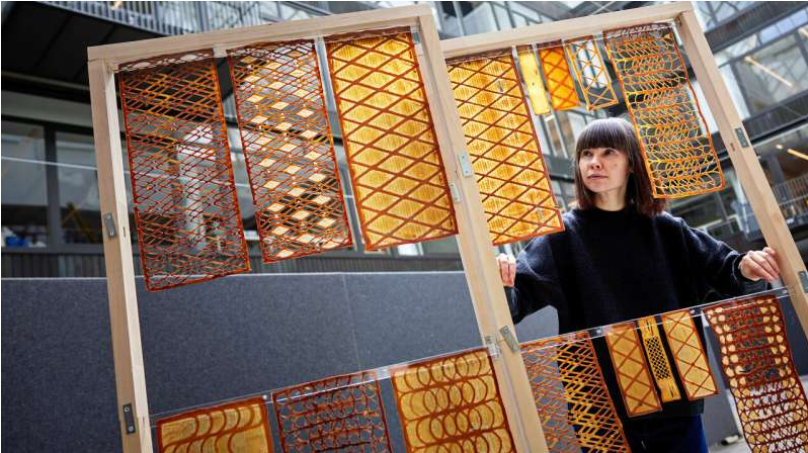
According to its developers, the yeast-derived material is 3D-printed and customized for use in architectural and interior design elements, currently manufactured using non-renewable or fossil-based materials like plaster, plastic or synthetic textiles. Such design elements, the team explained, might be daylight modulating and sunlight protecting screens, room partitions or wall systems, for instance.
 Source: Chalmers University of Technology | Henrik Sandsjö
The new material is comprised of baker's yeast, cellulose fibers from wood, alginate from algae, glycerol from plants and water. Altogether, these ingredients create a type of hydrogel that can be 3D printed.
To create the material, the team first heats the yeast to deactivate it, and then the assorted ingredients are mixed together, forming a smooth mass.
The team then uses pressure-based 3D printing at room temperature to create the architectural design elements. This process requires neither energy-intensive heating nor additional support structures.
"3D printing makes it possible to create complex shapes without producing waste. We can design and manufacture the material directly — with a high degree of control over its shape, texture and material distribution," the team added.
The material's transparency, color and surface texture can be modified with slight adjustments to the formula. This reportedly makes it appropriate for interior applications..
In the future, the yeast material might also become an environmentally friendly alternative to plastics and other petroleum-based products, including synthetic textiles.
"Yeast grows exponentially. It does not require strictly controlled environments and is not particularly sensitive to contamination. Because it consists of single-celled organisms, we can produce a more homogeneous, predictable material," the team added.
Importantly, the yeast-based material is biodegradable and can return to nature after use.
For now, additional research is needed before the material can be used in buildings and additional studies will need to be conducted to assess properties like strength, fire safety and moisture performance.
An article detailing the work, “Novel 3D printable yeast-based materials for architectural applications,” appears in the journal Frontiers of Architectural Research.