AI robots in industrial automation
Clare Naden, for IEC e-tech | April 29, 2026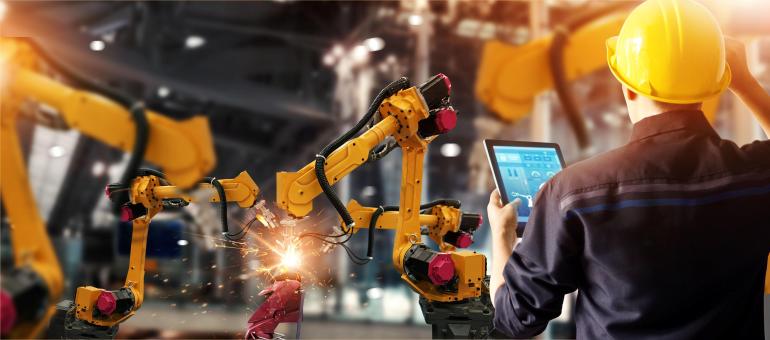
Editor's note: This article originally ran on e-tech and appears here courtesy of the IEC.
There is no doubt that robots are transforming industrial production. It is estimated that nearly 4,7 million industrial robots are at work in factories around the world, undertaking tasks as diverse as welding and assembly, picking and packing orders, as well as maintenance and quality control. The injection of AI is not just accelerating their growth but enabling the shift from simple tasks to complex ones, as well as greater collaboration with humans. Technologies such as machine learning algorithms, natural language processing, deep learning and the latest innovations in reasoning models are enabling robots to become more autonomous and intelligent.
How AI is improving industrial automation
- Perception: with the use of deep learning, AI robots can perceive and respond to their environments.This enables a variety of functions such as quality control, sorting, bin picking and palletizing.
- Autonomous mobility: data from multiple sensors is used to enable simultaneous localization and mapping (SLAM), meaning robots can navigate the factory floor while avoiding obstacles in their path.
- Natural language processing is enabling robots to understand voice commands and interact with humans, giving rise to collaborative robots that are designed to work alongside humans, are easily programmed and are equipped with sensors to avoid collisions.
- Machine learning algorithms are being used to anticipate problems and enable predictive maintenance, as well as more efficient production scheduling.
- Physical AI enables robots to integrate data from sensors to act on it in real time.
- Agentic AI combines analytical AI for decision-making and generative AI for adaptability, enabling robots to work independently.
What’s more, tech companies are increasing their investment in software that can train robots in simulated environments before they even reach the factory floor. This global technology giant provides a full-stack platform used by the entire robotics industry. Its open models and frameworks, including NVIDIA Omniverse, Isaac Sim and Isaac Lab, Cosmos and GR00T, it claims, accelerate the full robot development lifecycle, from synthetic data generation and simulation-based training to policy evaluation and deployment. The idea is to enable developers to build generalist-specialist robots capable of reasoning and performing a wide range of tasks across industries.
Perceive, plan and act
According to Akhil Docca, head of robotics product marketing at NVIDIA, AI-driven industrial robotics are able to perform three different operations, the first of which is perception, the second planning, and the third which is acting. Sensors and cameras feed data into deep-learning models that run on edge or data-centre hardware. These models handle perception – object detection, segmentation, pose estimation – so the robot understands what it sees and where things are. Planning and control algorithms then decide how to move (navigate, pick, sort, place) and send commands to the robot. Increasingly, much of this behaviour is trained and tested in simulated environments that mirror the factory, so that by the time robots are deployed on the floor, they have already been validated in software – a “sim-to-real” approach that reduces risk and speeds up rollout while letting teams in different geographies collaborate in the same virtual environment.
"These capabilities are enabling manufacturers to do what was previously impractical: run more flexible, higher-mix production lines while maintaining throughput and quality," he says. "Robots can handle increasingly complex material flow and adapt to varying parts, layouts, and configurations - reducing dependence on fixed, hard-automation solutions and giving manufacturers more room to respond to changing customer demand."
This German automotive company provides a good example of how this works. It is using AI-driven robots to speed up and improve the production line of their vehicles. The company sells around 2,5 million vehicles per year with 40 different models and around 100 different options per car, involving the movement of tens of millions of parts per day from many suppliers across multiple factories. Their AI-enabled robots handle navigation, part detection, pose estimation and manipulation so that the right parts arrive at the right place at the right time. The system was designed and trained using a mix of real and synthetic data and then developed and tested before being deployed in BMW’s factories.
The need for trust and how standards help
As robots become more and more autonomous, they pose greater risks simply because an error or malfunction could have serious consequences. Prior to this, errors in AI data remained a software problem. With physical AI, errors become a physical problem. Ensuring the quality and integrity of the data is paramount, and measures need to be in place to ensure human safety where people are collaborating with robots.
A number of publications have been developed to support this. The technical report ISO/IEC TR 5469, for example, paves the way for the development of safety-related systems using AI technologies by fostering awareness of the properties, functional safety risk factors, available functional safety methods and potential constraints of AI technologies. It serves as the foundation for a technical specification currently in development, ISO/IEC TS 22440, which will provide more detailed guidance and requirements.
The two standards are under the remit of a new joint working group (JWG 4) that brings together the AI expertise of the ISO/IEC committee for AI, SC 42, and the functional safety expertise of IEC TC 65/SC 65A, which is the subcommittee behind the IEC 61508 functional safety series. IEC TC 65 is the technical committee for industrial automation. The same joint working group is also working on a technical specification for calculating uncertainty in AI systems, ISO/IEC TS 25223.
“To address safety challenges, it is necessary to combine traditional safety principles such as monitoring and validation with new methods and processes addressing AI trustworthiness”, says Riccardo Mariani, who is the Convenor of JWG 4, Chair of the ad hoc group for AI in industrial automation and Co-convenor of the IEC 61508 series for functional safety. “From a safety point of view, manufacturing with AI-driven robotics, which involves increasing human-machine collaboration, requires novel safety approaches that combines inside-out safety – i.e. safety functions implemented in the robot – with outside-in safety – i.e. safety functions implemented in the warehouse of factory – to provide contextual awareness.” The working group is just one of many activities related to AI in automation that IEC TC 65 has been undertaking of late, coordinated by a recently established ad hoc group on AI in industrial automation.
In addition, several ISO Standards exist in the area as well, including ISO 10218-1/2 governing industrial robot design and integration, and ISO/TS 15066 covering collaborative robots.
Agents in industrial automation
Other TC 65 activities include new advisory and working groups in areas such as industrial agents and multi-agent systems, smart manufacturing, predictive maintenance and the application of AI in batch processing systems (for more on standards for batch processing, read this e-tech article). The newly formed IEC TC 65 WG 31 has launched the IEC 63718 series on agents in industrial automation, covering topics starting with fundamentals (Part 1). It is set to expand towards engineering methods, reasoning capabilities, quality measures and more. WG 31 is mandated to develop global standards for autonomous industrial agents and multi-agent systems, spanning software-only and combined software/hardware architectures.
“Industrial agents serve as an important bridge between robotics and automation, as well as between AI technologies and the manufacturing domain," says Prof. Christoph Legat, Convenor of WG 31. “This initiative builds on strong international support and establishes the first comprehensive, vendor-neutral framework for intelligent industrial agents in future automation systems.”
Cyber secure systems and conformity assessment
Effective governance of any AI system is essential to ensure it remains safe and takes into account aspects such as privacy and ethics. ISO/IEC 42001 helps organizations develop, provide or use AI systems responsibly, with guidance for establishing, implementing, maintaining and continually improving an AI management system. It can also be certified, thus providing reassurance to governments and stakeholders that the requirements have been implemented correctly.
Cyber security also needs to be considered in industrial automation, particularly as experts say robots could become the next key target for hackers. The IEC 62443 series continues to be the leading international standard for cyber security in industrial automation and control systems, combined with upcoming standards such as ISO/IEC FDIS 27090, which will give guidance for addressing security threats and compromises to AI systems.
As technology evolves, it is also important that personnel are equipped with the skills and knowledge to interact with it in a way that ensures safety for themselves as well as those around them. IECEE is the IEC System for Conformity Assessment Schemes for Electrotechnical Equipment and Components. Their Certification of Personnel Competence (CoPC) scheme takes a step in this direction. The programme assesses and certifies staff to provide proof they are competent in specific functional areas, as it relates to essential operational, security and safety-related conditions. In this way, it provides evidence of cross-industry competences needed for work in a variety of fields across multiple countries.
The scheme is currently limited to machine safety, but work has started on documentation to expand it to functional safety, in line with IEC 61508, and cyber security, in line with the IEC 62443 series. The CoPC scheme also contributes to the goal of “collaborative safety” as outlined in the IEC White Paper Safety in the Future and will be an important asset in the implementation of future technologies.
The manufacturing industry is experiencing a fundamental shift, says Rainer Schrundner, Chair of IEC TC 65. “Innovations such as agentic AI and AI-powered robots are increasingly changing how warehouses and factories operate worldwide. Ongoing standardization activities are paving the way for a safe integration of those innovations.”
In other words, standards bodies and industry are working hand in hand to ensure that this hugely innovative field of robotics remains safe, efficient and responsible in the future, as we move to increasing collaboration between humans and robots on the shop floor.