
A primer on electrical safety codes
N. Mughees | March 11, 2024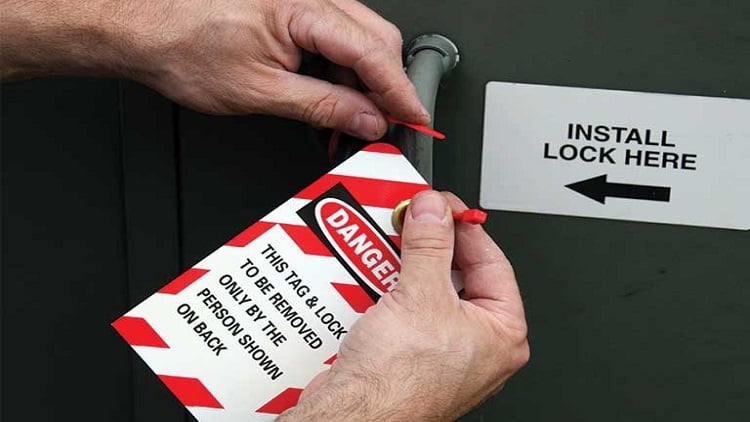 Placement of lock out tags as defined by international electrical codes. Source: Dcwcreations/iStockphoto
Exposure to electricity can be dangerous and potentially harmful, and can cause serious injury or death as well as property damage. While dealing with electricity or electrical equipment, there are simple measures one can take to lessen the likelihood of harm coming to oneself, coworkers and others in the vicinity. When dealing with electricity, the most common risks include:
- Burns or electric shock caused by electrical currents or contact with live components.
- Dangers posed by electrical arcs (when there is a continuous electrical discharge caused by the electrical breakdown of a gas).
- Fire events caused by malfunctioning electrical systems.
- Explosion brought on by improper electrical equipment.
- Static electricity can ignite combustible dust or vapors.
Another way electric shocks can cause harm is by triggering a fall, which is common when working on elevated platforms. It only takes a careless electrician to hook up a plug the wrong way to cause serious injury or even fire. That is why there is a need for electrical safety codes, which lay out uniform requirements for industry. To reduce these dangers, codes offer rules to follow as discussed in this article.
Although different countries have different electrical codes and standards, many regions use internationally recognized codes and standards as a reference. A few examples are as follows:
IEC (International Electrotechnical Commission) standards
As a global authority on electrical, electronic and related technology standards, the IEC creates norms for these fields. Broadly speaking, these standards address issues like electrical safety, testing and equipment design. For instance, the guidelines for electrical installation design, construction and verification are provided by IEC 60364-1. The regulations are put in place to ensure that people, animals and property are protected from harm that can come from electrical installations, while also making sure that those installations work properly.
In a similar vein, the IEC 61508, series of standards ensure functional safety throughout the electrical/electronic/programmable electronic system's and product's lifetime. The sensors, control logic, actuators and microprocessors that carry out automated safety functions are the parts that are addressed in this context. Analyzing the risks and hazards associated with a system or device is a requirement of the standard. One can use the categories it provides to figure out how likely something is to happen and what would happen if it did.
ISO (International Organization for Standardization) standards
Similar to IEC, ISO has also set electrical, electronic and related technology standards. For example, in order to ensure the safety of everyone involved, including operators, technicians, service/maintenance personnel and bystanders, ISO 14990-1:2016 lays out the general safety requirements for the electrical equipment and components that are part of earth-moving machines, as listed in ISO 6165. Under its scope, ISO 14990-1:2016 addresses all major dangers, dangerous scenarios and dangerous occurrences pertaining to the voltage range for earth-moving equipment, whether used as designed or under circumstances of abuse that the manufacturer could have reasonably anticipated.
NEC (National Electrical Code) standards
While the NEC is primarily used in the U.S., its influence extends internationally. Some countries adopt NEC standards or incorporate them into their local codes. A technical coordinating committee and twenty code-making panels of the National Fire Protection Association is responsible for developing the NEC. The following are examples of installations that are covered by the NEC: electrical conductors, signaling and communications conductors, and optical fiber cables and raceways. This installation could be anywhere from a private residence to a public or private building, structure, recreational vehicle, floating building, yard, lot, parking lot, carnival or industrial substation.
EN (European Norm) standards
EN electrical safety codes refer to the standards established by the European Committee for Electrotechnical Standardization (CENELEC). These standards cover various aspects of electrical safety, design, installation, and performance across Europe. For example, an EN electrical safety code is EN 60204-1:2018, titled "Safety of machinery — Electrical equipment of machines — Part 1: General requirements." This standard is part of the EN 60204 series, which focuses on the electrical equipment of machines.
EN 60204-1:2018 specifies general requirements for the electrical equipment of machines and outlines safety considerations to be taken into account during the design and construction of electrical systems associated with machinery. It covers aspects such as electrical supply, control circuits, emergency stop functions and protective measures.
Conclusion
Exposure to electricity poses significant risks, including burns, electric shock, fire events, explosions and other dangers. International organizations such as the IEC and ISO set global standards for electrical and electronic technologies. For instance, IEC standards address electrical safety, testing and equipment design, while ISO standards, like ISO 14990-1:2016, focus on specific applications such as the safety requirements for electrical equipment in Earth-moving machines. These international electrical codes provide a framework to protect individuals, animals and property from the potential hazards associated with electrical installations. Adhering to these codes is essential to ensure not only the proper functioning of installations but also the safety of those who interact with them.



You might also consider IEEE's NESC C2-2023.
This document's purpose is the practical safeguarding of persons during the installation, operation, or maintenance of overhead and underground supply and communications lines and their associated equipment. They also publish a companion handbook that helps illustrate the meaning and intent of the code.