The race to build cold-weather batteries
Shannon Cuthrell | May 11, 2026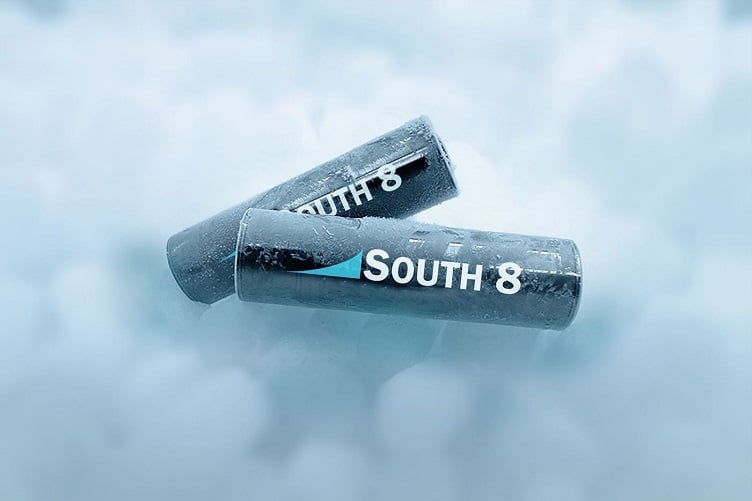 South 8 Technologies is looking into liquefied gas electrolyte instead of conventional lithium-ion cells to improve cold-temperature performance and safety. It is said the batteries can perform from about -60 °C to +60 °C. Source: South 8
Winter range loss has made cold weather battery problems familiar to many electric vehicle (EV) drivers. But low temperatures are a broader challenge than the automotive market alone. In the cold, reduced output and efficiency can shorten drone flight times, impair military electronics, limit field robotics and strain energy storage systems operating outdoors.
For years, manufacturers have managed those problems largely at the system level, using insulation, heaters and battery-management controls to keep cells within an operable temperature range. Those fixes can work, but they add weight, complexity and energy overhead. Now researchers and battery developers are looking to solve more of these problems inside the cell itself.
That challenge starts with basic electrochemistry. As temperatures fall, performance losses are driven by rising internal resistance and slower ion transport. Diffusion in the electrolyte slows, and charge transfer at the electrode-electrolyte interface becomes less efficient. If transport becomes too limited or the electrolyte begins to crystallize, performance can degrade rapidly. In practice, those limitations show up quickly at sub-zero temperatures: Conventional lithium-ion batteries can lose a substantial share of usable capacity (around 60%) at -20° C, though the exact drop varies by chemistry and operating conditions.
Engineers can address the problem in three areas:
- Electrolyte
- Electrode
- Overall system design
Low-temperature electrolytes are formulated to stay fluid and conductive, typically using low-viscosity solvent blends and additives that preserve ion transport. On the anode side, graphite is prone to lithium plating during cold charging, prompting the use of surface treatments or alternative materials such as lithium titanate. Cathode design also plays a role, as particle size, morphology and coating quality all affect how easily ions can move. At the system level, manufacturers still rely on insulation, internal resistance heating and active preheating to keep cells within an operable range.
Those limitations have prompted a wave of new approaches designed to keep batteries working deeper into sub-zero conditions.
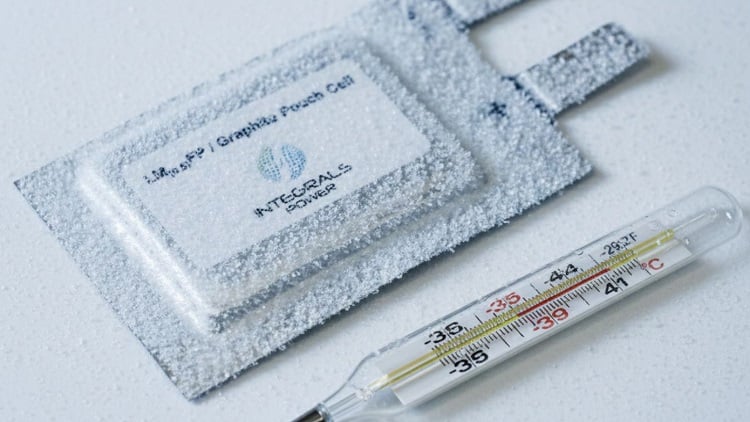 Lithium manganese iron phosphate batteries being developed by Integrals Power retain about 85% capacity at -25° C and 68% at -30° C. Source: Integrals Power
Rethinking battery chemistry for extreme temperatures
Engineers are proposing new chemistries to help batteries maintain performance in cold climates. At Texas A&M, Jodie Lutkenhaus and colleagues designed a polymer-based battery that can retain 55% capacity at -40° C.
Lutkenhaus said the team’s biggest challenge was identifying an electrolyte that would stay liquid at low temperatures while maintaining compatibility with the electrodes. "If the electrolyte freezes, the ions simply will not move," Lutkenhaus said. "We screened many different combinations of solvent and salts before we found the right one. We were measuring freezing points of the electrolytes, as well as whether the polymer electrode would degrade in a particular electrolyte."
The result is a system that can operate in much colder environments, albeit with a few limitations: Polymer materials come with trade-offs compared to traditional inorganic components. Lutkenhaus said the biggest compromise in organic batteries is their reduced energy density compared to traditional lithium-ion batteries.
"Organic batteries can operate more effectively at low temperatures, but their room-temperature energy density needs improvement," Lutkenhaus added.
For now, the team's next goal is to push performance to even lower temperatures. Scaling the design will likely be a major challenge because active organic materials are available now only in lab-scale quantities, Lutkenhaus said, meaning large-scale deployment would require much more manufacturing capacity for material synthesis.
Large manufacturers are also exploring alternative chemistries.
China-based CATL and BYD are investing heavily in sodium-ion technology, in part because of its low-temperature performance and reduced reliance on lithium supply chains. CATL and Changan Automobile recently launched what they claim as the first mass-produced sodium-ion passenger vehicle. CATL has reported that its Naxtra sodium-ion battery can retain more than 90% of its capacity at -40° C and deliver higher discharge power than comparable LFP batteries at -30° C. The company's latest annual report cited sodium-ion as a key R&D focus, with the market expecting high adoption in 2026 across energy storage, EVs and battery swapping applications.
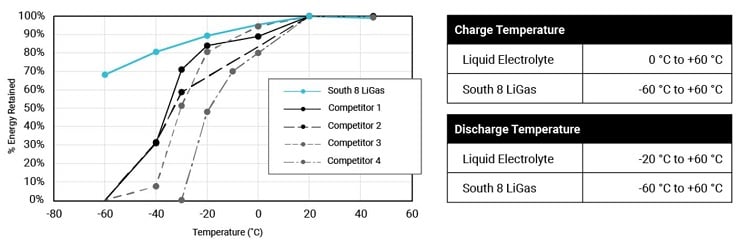 Performance of South 8's LiGas system compared to competitors. Source: South 8
South 8's liquefied gas electrolyte
California-based South 8 Technologies is pursuing a different electrolyte strategy. Its liquefied gas electrolyte (LiGas) system replaces conventional liquid electrolytes with compressed gases in liquid form, allowing lithium-ion batteries to operate at much lower temperatures without freezing. South 8 said its systems can function from about -60° C to 60° C.
South 8 CEO and co-Founder Jungwoo Lee argued that the battery industry still relies too heavily on engineering-level workarounds such as heaters and controls. “It’s a very logical approach, but it’s a very limiting approach,” Lee said. “It adds engineering challenges, weight and cost.”
South 8’s pitch is to solve more of that problem inside the cell itself. Lee compared the concept to canned air used for cleaning electronics, where liquefied gas rapidly cools as it expands, causing the can to feel cold. South 8 compresses gases into a liquid state and uses them as solvents in the electrolyte, blending them into formulations designed for batteries.
"Our secret sauce is how you control and blend it to make mixtures that are ideal for battery systems," Lee said. "Then, once we make the electrolytes, we then have to get them into battery cells, which is a level of manufacturing that South 8 is specialized in."
South 8 has focused its early commercial work on markets where cold exposure is hard to avoid, including drones and soldier wearables. "It's not unknown that drones are proliferating in terms of use cases. As the drone market grows, it’s going into more areas where low temperature has been highlighted as a deficit,” Lee said. “Having poor battery life is something impacting their missions and ability to perform.”
Indeed, batteries in drones, communications gear and other electronics can fail much faster than expected in the field. Recent exercises in Alaska found drones losing most of their flight time and soldiers' mobile tablets failing as batteries struggled in sub-zero conditions.
Reworking the cathode
U.K.-based Integrals Power is tackling low-temperature limitations from another direction, focusing on lithium manganese iron phosphate (LMFP), a cathode chemistry positioned between LFP and higher-energy nickel-rich materials. The company reports that testing by Cranfield University found its LMFP pouch cells retained 85% capacity at -25° C and 68% at -30° C.
Behnam Hormozi, CEO and founder of Integrals Power, said cold weather performance depends heavily on internal resistance, but also on the physical structure of the cathode material itself. Particle size distribution, surface area, porosity and carbon coating quality all affect how easily lithium ions can move through the material, especially as temperatures fall.
"We've addressed those issues by coming up with our own unique morphology. In essence, instead of having one dimension for the lithium ions, we've added another two dimensions, so it's a three-dimensional way for the lithium-ions to move more freely and faster," Hormozi said. He compared the approach to adding more exits to a crowded room.
“If you have 10 people (lithium ions) stuck in a room and there’s only one way to get in and out of that room, adding another two doors will increase your chances of having everyone leave the room at a much faster pace, and more freely,” Hormozi said.
The company's technology focuses on enhancing energy density and power through optimizing the particle structure via nano-sized particle approaches. Hormozi said Integrals is also pushing the manganese content of LMFP higher than most developers, as high as 80%, arguing that this can raise voltage and improve energy density relative to standard LFP while preserving safety advantages important in sectors such as defense and maritime systems. That positioning, he said, has helped draw interest from both automotive and defense customers.
Most interest has come from EV and auto sectors, Hormozi said, though defense has also emerged as a key market due to LMFP's safety advantages over conventional lithium-ion and nickel manganese cobalt (NMC) systems .
“We’ve seen some interest from defense because safety is one of the most important factors," Hormozi said. "At the moment, NMC or LFPs have been very active in that sector. You can either have a high safety with LFP or a higher energy density [with NMC], but you can’t have both together. So, LMFP can tackle that.”
Scaling from lab to manufacturing
Researchers and companies have already confirmed that low-temperature battery performance can be improved, but whether those approaches can scale economically and reliably into real products is a different challenge entirely.
South 8, founded in 2015, is now moving from prototyping to production, recently raising an $11 million funding round to accelerate LiGas production for early customers. Publicly announced partners now include LG Energy Solution, Galvion and 3ME. Lee said South 8’s first production line in San Diego will be around 10 megawatt-hours (MWh), with plans to scale to hundreds of MWh over the next two years for early customers in drones and robotics, then other potential markets. The broader strategy is to integrate its electrolyte technology into larger partner factories, rather than building every future plant from the ground-up, Lee said.
Integrals Power is currently producing materials at pilot scale, with roughly 20 tonnes per year, and plans to expand to 100 tonnes in the near term and 1,000 tonnes longer term. In the next few months, Hormozi said the company is focused on building up its processing capabilities to supply large quantities of samples for feedback.
The company has raised roughly £5 million (around $6.65 million USD) to date through a combination of U.K. government support and private funding. Hormozi said Integrals is also positioning its non-Chinese supply chain as a commercial advantage.
"I'm pleased to say that we are effectively working on a non-Chinese supply chain. That’s something we're very proud of, and I think another reason why a lot of companies have reached out to us," said Hormozi, noting broader industrial interests in building a more secure supply chain and reducing carbon footprint.
Conclusion
Cold-weather batteries are becoming part of a broader push to adapt electrified systems to harsher, more variable environments. The challenge now is which approaches can maintain performance in the cold without giving up too much in cost, energy density or manufacturability.