New antimicrobial targets dry-food processing equipment cleaning, sanitation
Marie Donlon | April 18, 2026In a bid to prevent pathogenic contaminations like salmonella in dry food processing facilities, researchers from the University of Massachusetts Amherst have developed a new chemical mixture for sanitation in low-moisture environments.
Dry sanitation practices are critical for facilities where dry foods like spices, grains, chocolate and milk powders are manufactured. In such facilities, water use during cleaning is limited because residual moisture tends to create harbor-sites for pathogens, thus increasing food safety risks. Because of this, dry sanitation practices are essential. Without water-based cleaning and sanitation methods, food safety professionals are turning to alternative approaches, such as alcohol-based mixtures, which, thanks to their flammability, pose potential safety risks to both workers and facilities.
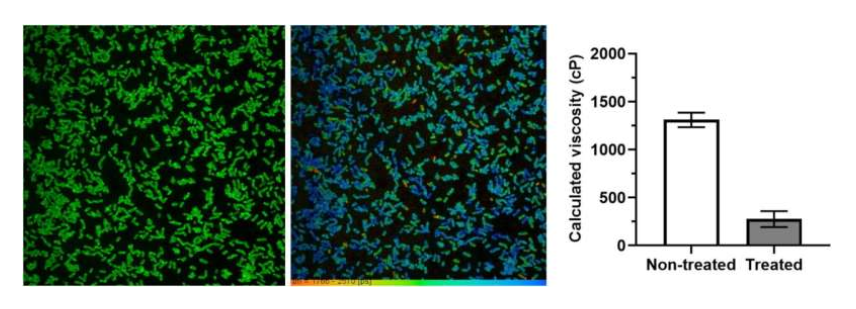 Exposure to cyclomethicone D5 increased the fluidity of bacterial membranes. Source: Journal of Food Protection. DOI: 10.1016/j.jfp.2026.100716
As such, the team evaluated how antimicrobial liquids formulated with volatile, nonpolar liquids such as cyclomethicone and isoparaffin performed against Salmonella and Cronobacter bacteria, which pose food safety risks.
During these evaluations, the team discovered that a formulation featuring cyclomethicone mixed with vinegar-based acetic acid proved the most effective against the target pathogens. Further, the formulation has a high flashpoint — which is the temperature at which a substance can ignite if exposed to a spark or flame. Because this flashpoint is well above the temperatures often encountered in dry-food processing environments, this offers another layer of safety.
Further, this new formulation contains only 3% water, versus the 30% for traditional products.
"All dry-cleaning products need some moisture to enhance the microbial kill," the researchers added, "but too much moisture can raise the relative humidity in a plant. More humidity can then lead to more microbial survival and possibly blunt efforts to decontaminate the environment."
The team further confirmed the antimicrobial system with a hand-cleaning approach for surface contamination in the presence of food residues. The new low-moisture antimicrobial liquid decontaminated a stainless-steel surface following a round of extensive physical cleaning.
The team discovered that the low‑moisture antimicrobial liquid made with cyclomethicone and acetic acid rapidly reduced Salmonella and Cronobacter on stainless steel surfaces, without the flammability concerns of alcohol-based cleaners.
An article detailing the formulation, “Development and Validation of an Evaporative, Low-Flammability, and Low-Moisture Antimicrobial Liquid for Dry Cleaning and Sanitization of Food Processing Equipment,” appears in the Journal of Food Protection.