Digital isn’t enough: The real challenge behind flowmeter innovation
Diana Aoun | March 11, 2026While artificial intelligence and ‘Industry 4.0’ dominate industrial headlines, it is easy to assume that software, connectivity and AI are the sole drivers of progress. Although the significant effects of this new digital era are undeniable, the advances in fundamental hardware design and capability deserve just as much attention. One area that has demonstrated the importance of continued advancement in hardware technology is flow measurement.
From the oil and gas sector and chemical processing to beverage production and HVAC systems, countless industries depend on precise flow measurements in their operations. Understanding the movement of liquids and gases within a system is essential for achieving optimal performance. By providing precise data on fluid flow rates, they empower industries to streamline operations, minimize waste and maintain strict safety standards. Recent advances in flow measurement technology demonstrate that while digitalization offers valuable capabilities, real breakthroughs are happening where the fluid meets the metal (or the ultrasonic wave).
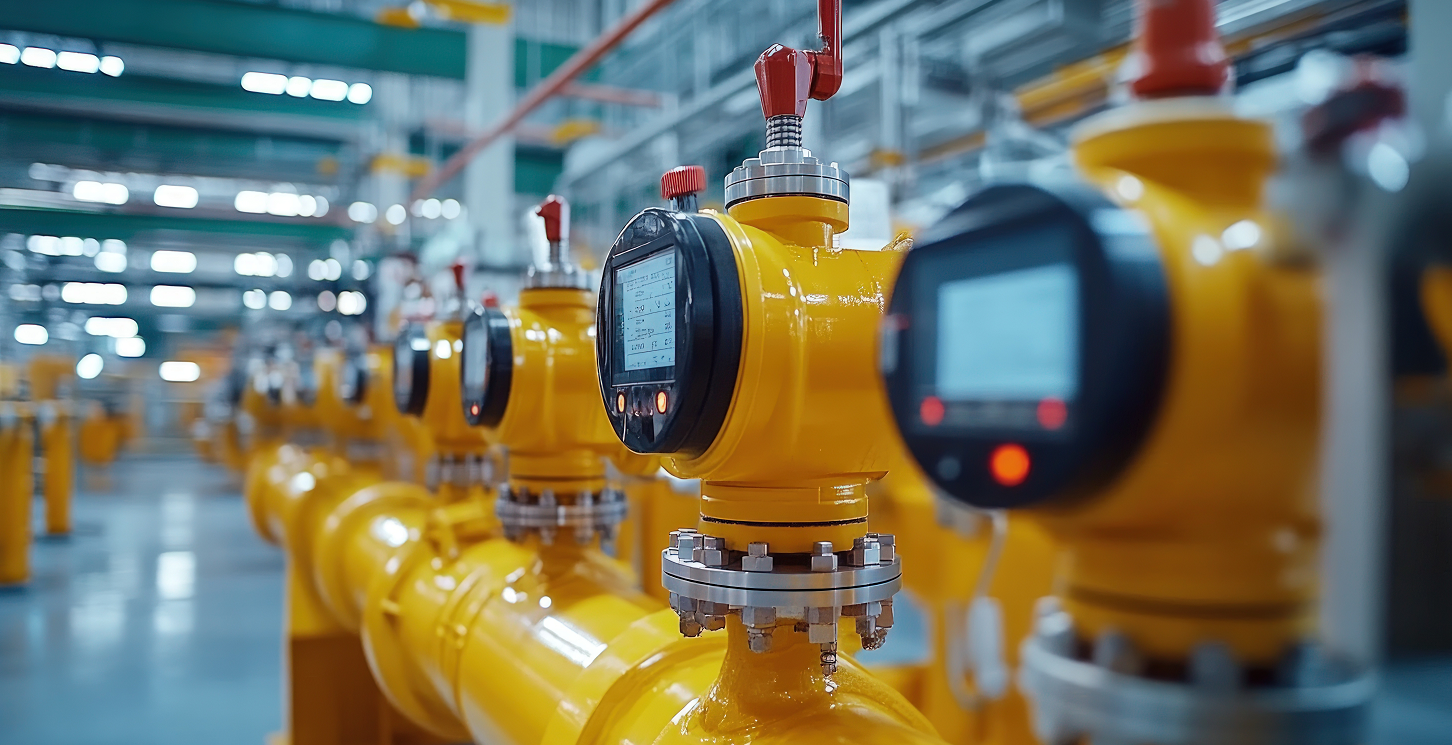 Industrial flowmeter. Source: Ahmad Juliyanto/Vecteezy
The hardware innovations beneath the data
Recent product developments in flowmeter technology reveal that these physical measurement devices themselves are undergoing dramatic improvements, unrelated to cloud connectivity or AI, but equally, if not more, important.
The evolution of turbine flowmeters, which remain workhorses for measuring light viscosity fluids such as glycol, water and solvents, is a key example of these advancements. Turbine flowmeters are precise, mechanical devices that measure liquid, gas and vapor flow rates by using fluid velocity to rotate an internal rotor. The latest generation achieves accuracy within ±1% of reading and repeatability of ±0.1% across flow ranges from as low as 0.3 gallons per minute (0.02 L/s) to as high as 5,500 GPM (347 L/s). This level of precision — made possible by all-stainless-steel construction and tight machining tolerances — ensures reliable performance and long-term durability even in demanding industrial applications.
Ultrasonic flowmeter technology has also taken a significant leap forward. Flow devices that clamp onto existing pipes and eliminate the need to penetrate process media have now reached significantly higher accuracy than their predecessors. The latest generation features high-performance volumetric and mass flow sensing technologies, along with disturbance correction that maintains accuracy even in challenging conditions such as disturbed flows. With no process media pressure limitations, these meters can safely and accurately measure flow in anything from a low-pressure water line to a high-pressure oil line.
Advancements in Coriolis flowmeter design
Another notable development in flow measurement technology is the improvement of Coriolis flowmeters (i.e. flowmeters based on oscillating tube principles), to achieve mass flow accuracy of approximately 0.1%. This is five to 10 times more precise than most conventional devices. While this level of accuracy is not new, recent innovations combine it with entrained gas management, which enable continuous operation during two-phase flow conditions that typically cause measurement interruption. While accuracy may temporarily deviate during such events, the system maintains repeatable performance and uninterrupted process control.
In addition, the latest generation of Coriolis flowmeters use straight tube designs to reduce pressure drop and handle shear-sensitive fluids more effectively than bent tube alternatives. Together, these advancements transform what a single instrument can achieve by simultaneously measuring mass flow, density, and temperature, delivering comprehensive process insights from one installation point.
The importance of integration
Advanced flowmeters increasingly incorporate capabilities that blend improved sensor hardware technology with digitalization. This includes synchronized channel averaging for precise gas measurements, dynamic compensation for mass and volume, and onboard diagnostics. But, as demonstrated by recent flowmeter innovations, hardware remains the foundation.
Industries that focus exclusively on digitalization and leveraging AI risk implementing advanced software based on legacy hardware that might not be up to the job. This can lead to operational risks and financial waste. In the case of flowmeters, the data flowing into control rooms and enterprise systems is only as good as the sensors generating it.
Manufacturers developing these products understand the importance of physical design because installation constraints and application needs vary widely across industries. Oil pipelines, water applications, aerospace test systems, automotive plants, HVAC installations, beverage processing, power generation; each presents unique challenges that demand tailored hardware solutions to meet increasingly stringent production, safety and environmental requirements.
Conclusion
For manufacturers and plant operators, it is clear that keeping up with innovation means paying attention to both hardware and software, because data quality is directly tied to the sensors generating it. The latest generation of flowmeters offers capabilities that include higher accuracy, broader application ranges, specialized models, easier installation, greater durability and better compatibility with digital systems.
As industries demand greater accuracy, reliability and adaptability, flowmeters are meeting these demands through a combination of innovative physical design, precise manufacturing and embedded intelligence. The latest generation demonstrates that hardware innovation is not optional, but rather, an essential prerequisite for digitalization.