New slippery coating keeps coffee, milk and soup from sticking
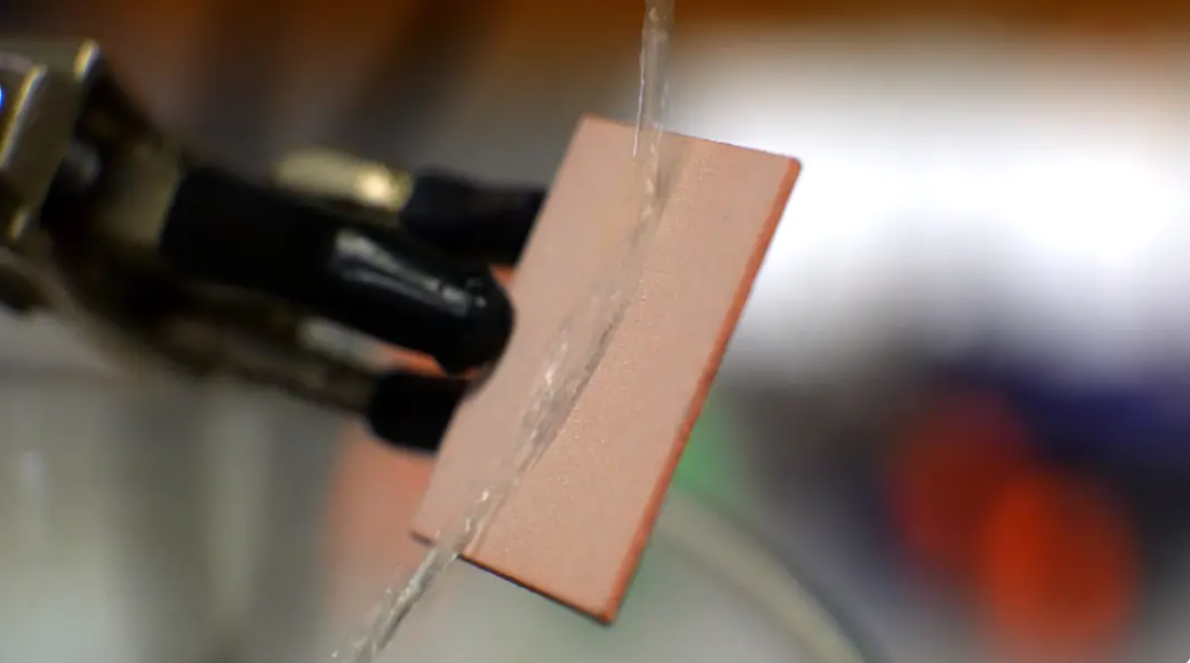
Marie Donlon | February 25, 2026A multilayered insulated superhydrophobic (MISH) coating capable of repelling near-boiling water, hot milk, coffee and soup that promises to help never-wet surfaces stay effective even at high temperatures has been developed by a team of scientists from Rice University.
To accomplish this, the team devised a quick fix for highly water-repellent superhydrophobic surfaces, which causes water droplets to roll off, by experimenting with the heat flow of the material rather than focusing exclusively on its chemistry and texture.
 Source: Rice University
Despite superhydrophobic surfaces being highly water‑repellent, hot water continues to present a major weakness. Once temperatures reach 104◦ F, water-repellent coatings tend to lose their water-repelling abilities. Rather than rolling off surfaces, the hot droplets stick and seep into the surface texture, leaving behind wet patches.
As such, the team created a coating that repels water even when the droplets near 194◦ F. This is thanks, according to its developers, to the MISH coating’s two-layer design system, which includes a spray-on polyurethane foam that functions as an insulating layer, and a microtextured superhydrophobic topcoat, which is a commercially available spray-on coating.
The underlayer slows heat transfer from the droplet into the surface and prevents the instant evaporation-condensation cycle that typically obliterates the trapped air pockets that cause water repellency.
“The insulation layer reduces the cooling of the hot droplet at the interface, which in turn reduces evaporation and recondensation cycles that normally flood the surface texture with condensate,” the team said. “Less condensate in the surface texture means fewer liquid bridges, which keeps repellency intact.” In the absence of those condensate bridges, even near-boiling droplets will continue to glide off.
The team noted that the surface works outside the lab, in real-world situations and across both large and curved surfaces — from pipes to bowls to industrial equipment.
In the lab, the scientists subjected coated samples to a barrage of hot droplets over the course of a week. Conventional coating broke down almost instantly while the MISH-treated surfaces, particularly those with thicker insulation, stayed repellent for more than 80 hours, before gradually degrading.
Meanwhile, outside the lab, the team applied the coating to large metal plates, curved pipes and exposed them to common liquids like hot milk, coffee and even split pea soup. On the MISH-treated surfaces, the fluids left less than 1% residue and a more than 31% residue was left on surfaces treated with standard coatings.
A study detailing the coating, “Scalable Hot-Water-Repellent Superhydrophobicity via Thermal Insulation," appears in the journal ACS Applied Materials & Interfaces.
For more information on the coating watch the accompanying video that appears courtesy of Rice University.