Battery efficiency boosted with flower power
S. Himmelstein | February 26, 2026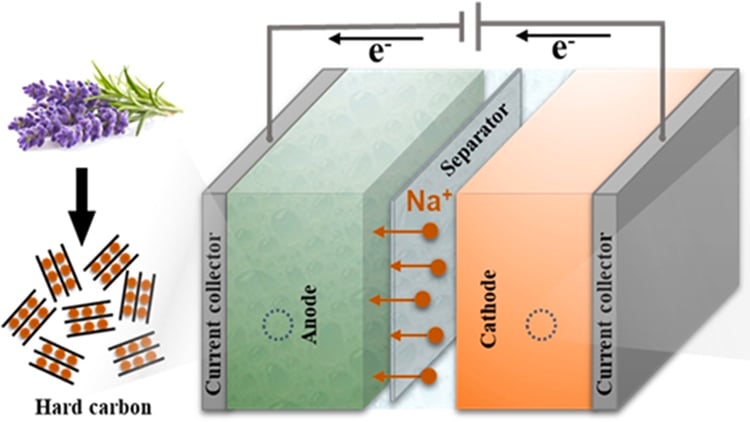 Schematic of the sodium-ion battery design. Source: j.jpowsour.2026.239365
The performance of sodium-ion batteries can blossom with the use of innovative anode and cathode materials. An international research team has designed a battery with sustainable, low-cost ingredients that promote cycling stability and enhance energy density.
These improvements were realized by use of sodium/magnesium/nickel/oxygen prismatic type layered oxides in the cathode. The anode was composed of hard carbon (HC) derived from lavender flower waste to improve cell performance. These widely available precursors offer economical alternative materials for sodium-ion battery design.
Spectroscopic and microscopic analyses revealed the formation of micrometer-sized cathode grains, a porous hard carbon surface and good structural stability. The inclusion of nickel was also observed to improve the cathode’s structural, electronic and electrochemical performance.
Electrochemical testing results published in the Journal of Power Sources document initial capacities of 200 mAh/g for the cathode and 360 mAh/g for the anode with capacity retentions of 42% and 67.4% after 100 cycles. Nickel doping was found to improve the cathode’s conductivity and stability, and the anode demonstrated good sodium storage performance, supporting strong half-cell and potential full-cell performance, according to the researchers.
Researchers from Inonu University (Turkey), Korea Institute of Science and Technology (Republic of Korea), Aksaray University (Turkey), Malatya Turgut Ozal University (Turkey), Quaid-i-Azam University (Pakistan), Erciyes University (Turkey) and Istanbul Technical University (Turkey) contributed to this development.