Rapid microfluidic system identifies pathogens in less than 20 minutes
Marie Donlon | January 12, 2026Researchers at the University of Glasgow have developed a new diagnostic platform for identifying microbial infections in as little as 20 minutes.
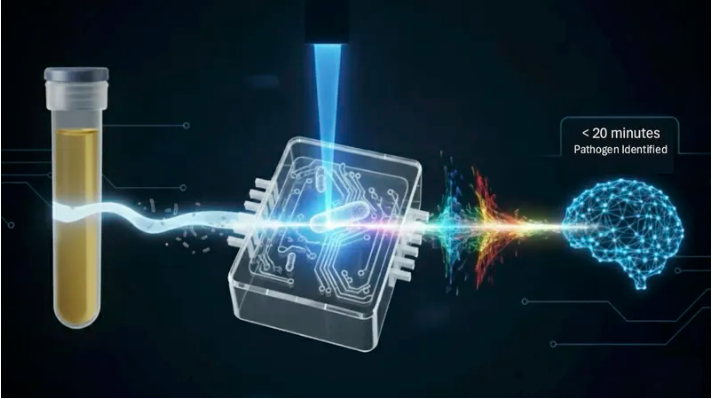
According to its developers, the AutoEnricher combines microfluidics, Raman spectroscopy and deep learning to instantly identify very low concentrations of pathogens and diagnose multiple infections at once.
 Source: University of Glasgow
The team believes that such a system has the potential to be a powerful tool against antimicrobial resistance (AMR), which, as the name suggests, is resistance to antibiotics.
By quickly diagnosing the cause of infections, AutoEnricher could potentially prevent the overuse of antibiotics, which is partly driving the AMR crisis, according to experts.
“One of the major drivers of antibiotic resistance is the misuse or overuse of drugs to treat infections,” the team explained. “Currently, it can take days or even weeks to culture microbes taken from patient samples in the lab to enable diagnosis. That means doctors often have to act urgently and use antibiotics to treat patients suffering from life-threatening conditions like sepsis or pneumonia without knowing for sure if they actually have a bacterial infection.”
As such, the team set out to develop AutoEnricher, which works in two stages. During stage 1, a microfluidic device scrubs human cells from samples of blood, urine or spinal fluid to leave behind only pathogen cells. At stage 2. Raman spectroscopy is used to determine the unique chemical fingerprints of the pathogens present. Meanwhile, a deep learning model — which was trained on a database of 342 clinical isolates from 36 species of bacteria and fungi — will then deliver a diagnosis in under 20 minutes.
During trials conducted at three different hospitals, AutoEnricher’s diagnosis matched conventional lab results 95% of the time.
“We’ve shown that this single-cell approach to diagnosis can rapidly deliver remarkably accurate results, and even pick out multiple infections which are much harder to spot using conventional lab culture methods,” the team concluded.
The device is detailed in the article, “Rapid culture-free diagnosis of clinical pathogens via integrated microfluidic-Raman micro-spectroscopy,” which appears in the journal Nature Communications.