How non-thermal food processing helps lock in nutrients
Jody Dascalu | January 30, 2026Conventional thermal processing has long underpinned food preservation. Pasteurization, sterilization and drying reduce microbial loads and extend shelf life, but they rely on sustained high temperatures. This exposure can degrade heat sensitive vitamins and polyphenols, alter flavor and color, and in some cases form undesirable compounds. Longer processing times required for sufficient microbial reduction amplify these effects.
Non-thermal processing encompasses technologies that achieve microbial inactivation and enzyme control at ambient or mildly elevated temperatures, often with shorter treatment times. These include ultrasound, high hydrostatic pressure processing, pulsed electric fields, cold plasma, ultraviolet light and irradiation. Among these approaches, ultrasound, high pressure processing and pulsed electric fields have drawn significant research and industrial interest due to their ability to preserve nutritional and sensory quality while meeting food safety requirements.
 Industrial food processing line showing large-scale handling and inspection of fresh produce in a modern facility. Source: Arno Senoner/Unsplash
Rising consumer demand for fresher, minimally processed foods has accelerated interest in these technologies. At the same time, advances in equipment design and process control have supported their broader adoption across a range of food products.
Mechanisms of microbial and enzyme inactivation
Non-thermal methods achieve microbial safety through physical and biochemical mechanisms that differ fundamentally from conventional heat-based processing. Instead of relying on elevated temperatures to inactivate microorganisms, these approaches act directly on cellular structures using mechanical, electrical or pressure driven forces.
In ultrasound treatments, high frequency sound waves generate cavitation within the product. Microscopic bubbles form and collapse, releasing localized energy that ruptures microbial cell walls and membranes. These extreme conditions are confined to micro scales and do not significantly raise the temperature of the surrounding material. A similar focus on targeted disruption applies to high pressure processing, where hydrostatic pressure is applied uniformly throughout the product. This pressure alters non-covalent interactions in cellular structures, compromising membranes and inhibiting key enzymatic activity without reliance on heat transfer or product geometry.
Pulsed electric fields operate through electroporation. Brief, high intensity electrical pulses create pores in microbial membranes, leading to cell death. Treatment times are short, which limits temperature rise and reduces thermal damage to heat sensitive compounds.
Across these technologies, microbial inactivation results from structural disruption rather than thermal effects. This distinction explains their ability to control pathogens and spoilage organisms while largely preserving smaller molecules such as vitamins and phenolic compounds.
Effects on nutrient retention and bioactive compounds
Recent studies have examined the effects of non-thermal processing on phenolics, flavonoids, anthocyanins, vitamins and overall antioxidant capacity across a range of food matrices. Compared with thermal methods, results are generally neutral to positive in terms of bioactive retention.
High pressure processing and pulsed electric fields often preserve phenolic content and antioxidant capacity when applied at appropriate intensities. Total phenolic levels typically remain stable, while total flavonoid content frequently increases relative to fresh controls. This pattern has been reported across fruit juices, purees and other plant-based products.
Anthocyanin responses are more variable. Pulsed electric fields can produce meaningful increases relative to untreated samples, while high pressure processing shows smaller gains, most evident at higher pressure levels. Thermal treatments can also increase anthocyanin content in some matrices, indicating that both thermal and non-thermal methods may enhance extractability through cellular disruption.
This distinction between enhanced release and true preservation is important. In many cases, increased bioactive levels reflect improved extraction rather than new compound formation. Pulsed electric fields appear particularly effective in increasing bioaccessibility through electroporation. Following simulated gastrointestinal digestion, pulsed electric field treated samples often show the highest phenolic and anthocyanin bioaccessibility, suggesting that released compounds remain available for absorption.
Vitamin C exhibits a more complex response. High pressure processing generally preserves ascorbic acid levels immediately after treatment, often comparable to untreated samples. During refrigerated storage, however, vitamin C may decline more rapidly in high pressure treated products than in thermally pasteurized ones. This behavior varies by food matrix and highlights the difference between initial retention and storage stability.
Overall, outcomes depend strongly on both product characteristics and processing parameters. Protective effects diminish beyond certain intensity thresholds, and individual compounds respond differently under identical conditions.
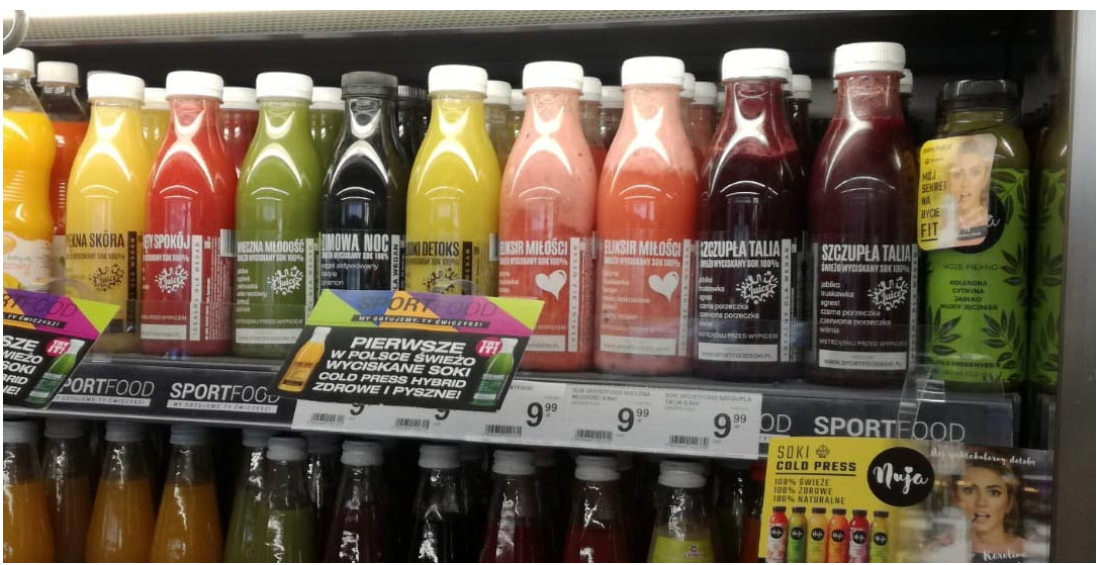 Cold pressed juices in store. Source: Lipcio/CC BY-SA 4.0
Technology-specific performance trends
Non-thermal technologies show different strengths depending on product type and processing goals. Ultrasound and pulsed electric fields are most effective in liquid systems, where cavitation and electroporation support microbial reduction and enhance the release and bioaccessibility of phenolic compounds. In these applications, pulsed electric fields often produce higher bioaccessibility values than thermal or high pressure treatments, while reported increases in anthocyanins are largely attributed to improved extraction rather than compound formation.
High pressure processing provides uniform microbial inactivation independent of product geometry and generally preserves phenolics and flavonoids well. However, vitamin C stability during refrigerated storage can be less favorable than in thermally processed products, highlighting a tradeoff between immediate retention and longer term stability. Overall, no single technology consistently outperforms the others, and selection depends on the food matrix, target compounds and quality priorities.
Industrial relevance and implementation constraints
Adoption of non-thermal processing at industrial scale remains constrained by cost, energy use and system integration. Equipment investment exceeds that of conventional thermal systems, particularly for high pressure processing, which requires specialized pressure vessels, and for pulsed electric fields, which rely on high power electrical components. These capital demands limit uptake among smaller processors.
Energy requirements vary by technology and application. High pressure processing involves substantial energy input for pressurization, while pulsed electric fields operate with short treatment times but high instantaneous power demand. Direct energy comparisons with thermal processing remain dependent on product, throughput and operating conditions. Regulatory acceptance also differs by technology. High pressure processing is widely approved for commercial use in juices, ready to eat meats and seafood, whereas pulsed electric fields continue to follow more limited regulatory pathways. Integration into existing processing lines requires dedicated engineering, as these systems do not align directly with conventional thermal equipment.
Post processing shelf life remains a critical consideration. Although non-thermal methods can achieve microbial reductions comparable to thermal treatments, storage stability can differ. Vitamin C losses observed during refrigerated storage in some high pressure treated products illustrate that strong initial retention does not guarantee long-term stability. Cold chain control therefore remains essential, particularly where residual enzyme inactivation is limited.
Current evidence supports non-thermal processing as a viable option for targeted applications rather than a universal replacement. These technologies offer advantages in preserving heat sensitive compounds and fresh like qualities, while cost, storage behavior and regulatory scope continue to constrain wider adoption.