Shape-shifting microrobots emerge from CU Boulder
Marie Donlon | January 08, 2026Microorganism-inspired particles capable of changing shape and propelling themselves in response to electric fields have been created by a team of researchers from the University of Colorado Boulder (CU Boulder)
According to the researchers, the shape-shifting ‘active particles’ could potentially function as microrobots for targeted drug delivery in hard-to-reach parts of the body, or as the foundation for responsive, self-healing materials.
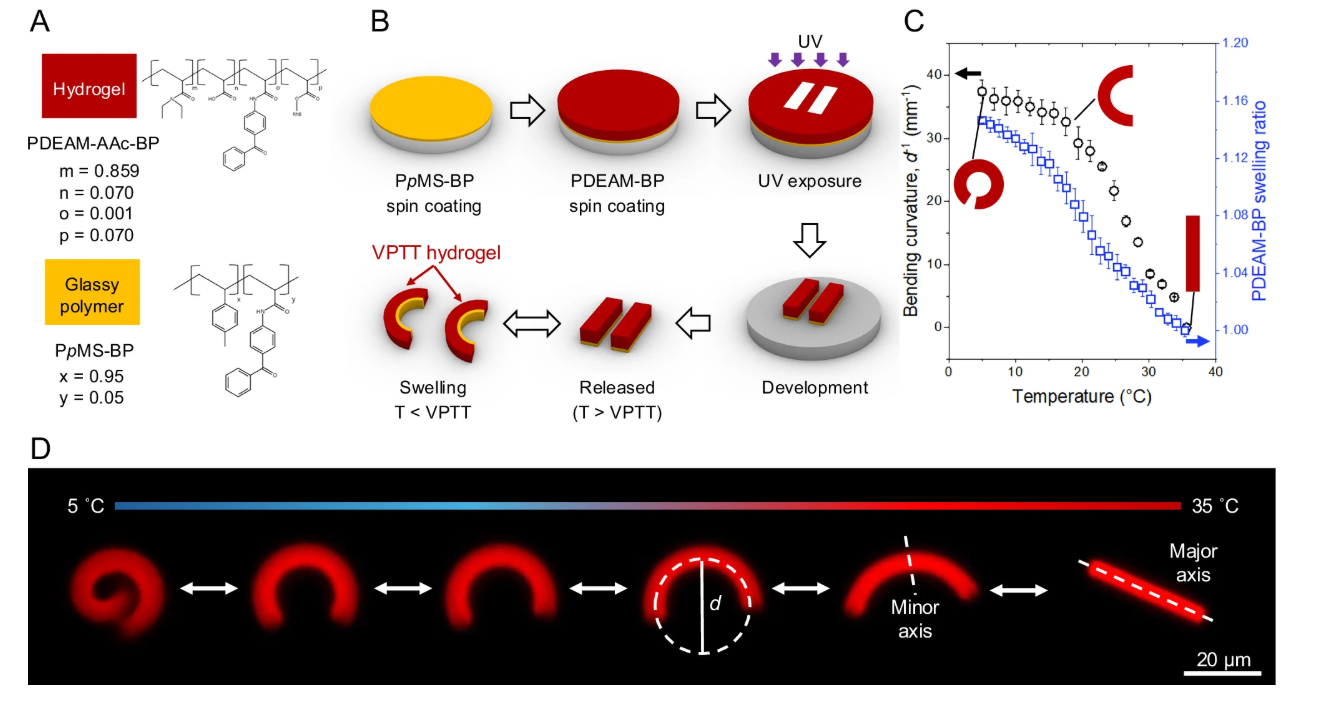 A) PDEAM-BP is a stimuli-responsive swellable hydrogel, and PpMS-BP is a glassy polymer. B) Schematic representation illustrating fabrication of shape-morphing particles from a bilayer of PpMS-BP (rigid layer) and PDEAM-BP (swelling layer) by UV-crosslinking and developing. C) Bending curvature of a shape-morphing particle (black circles) and linear swelling ratio of PDEAM-BP, defined as the ratio in diameter of a PDEAM-BP sample compared to that in its dry state (blue squares), as a function of solution temperature. Data points represent mean values, and error bars indicate mean ± SD (n = 5). D) Fluorescent microscope images showing reversible bending of a bilayer particle upon decreasing temperature across VPTT. Source: Nature Communications
“This discovery opens new possibilities for precise, programmable control of microrobots, enabling them to adapt their motion to different environments or tasks,” the team explained.
Inspired by active particles, which take energy from the surrounding environment and convert it into propulsion, the CU Boulder-developed particles are thought to be among the first of those that are capable of changing their shape as well as their responsiveness to electrical stimulation.
The team noted that active particles were initially modeled on microorganisms and primarily used to observe how microscopic swimmers like bacteria move and organize. Newer research is leaning toward practical applications by harnessing controlled motion. To better mimic biological swimmers — which can change both shape and motion to reach their intended targets — the CU Boulder team created soft, shape-morphing active particles that can bend, reconfigure and steer themselves.
These particles reportedly measure up to 40 µm in length, which is thought to be comparable in size to some larger bacteria and other microorganisms. The particles are comprised of a soft hydrogel layer that expands and contracts with water absorption, and a rigid, glassy layer that remains unchanged.
As the surrounding temperature changes, the hydrogel layer responds by changing its size — absorbing water and swelling at cooler temperatures and releasing water and contracting at warmer temperatures. Since the glassy layer is unchanged, the alterations in the gel layer bend the particle into a new shape.
During trials of the material, the team placed the particles in a chamber filled with water within an AC electrical field. When they adjusted the temperature of the water, this encouraged the particles to change shape and organize themselves in specific directions. The AC electric field then polarized the particles, prompting the ions in the hydrogel and the surrounding water to flow.
This so-called asymmetric ion flow enabled the team to propel the particles around in such a way that is controlled by both the shape and composition of each layer.
“By adjusting the temperature of the water, we can reversibly alter the shape and effective polarizability of the particles,” the team added. “This allows us to effectively change the direction and type of propulsion in real time.”
An article detailing the particles, “Shape-morphing active particles with invertible effective polarizability for configurable locomotion and steering,” appears in the journal Nature Communications.