Beyond round: Tubing shapes that optimize performance
January 01, 2026Shaped tubing isn’t just about appearance — it’s about function. From streamlining performance to space savings, it’s built to solve real engineering challenges.
When performance is critical, tubing shape goes beyond appearance — it drives results. Precision-shaped tubing enhances flow control, structural integrity and optimizes space in applications where precision is non-negotiable. From teardrop shapes that reduce drag in fluid systems to hexagonal forms that resist torque in aerospace assemblies, shape can directly impact performance. The 300 series stainless steels, including types 304 and 316, are ideal materials for precision-shaped tubing due to their excellent corrosion resistance, formability and strength. These alloys maintain their integrity during the shaping process.

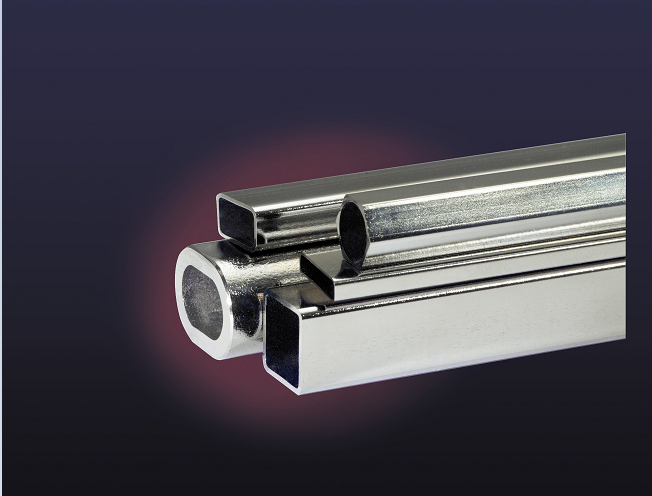
Industries like medical devices, aerospace instrumentation and analytical systems rely on shaped tubing to meet demanding specs and regulatory standards. Eagle’s advanced capabilities allow for the production of virtually any geometry — teardrop, oval, hexagon, square or custom — with consistent quality.
 Source: Eagle Stainless Tube & Fabrication Inc.
While round tubing remains widely used, it isn’t always the right solution. In environments where fluid handling, structural demands or spatial constraints are critical, shape becomes a performance factor, not just a design detail. Precision-shaped tubing provides specific performance benefits including streamlined fluid movement with oval designs, square or hexagonal forms enhance mechanical stability, and custom geometries allow for seamless integration into complex assemblies. By thinking beyond round, engineers gain precise control over both internal and external performance.
Shapes
Teardrop-shaped tubing improves flow by reducing drag, enhances directional strength and fits efficiently into compact assemblies. Its smooth contour supports cleanability and meets demanding performance specs.
Oval tubing offers streamlined flow, improved grip and space-saving integration. Its elliptical geometry enhances strength, reduces drag and fits compact assemblies — ideal for medical, structural and design-driven applications.
Hexagonal tubing offers superior grip, torsional resistance and stackable geometry. Its flat sides distribute stress evenly, making it ideal for structural, mechanical and precision-engineered applications.
Square tubing offers uniform strength, clean edges and easy integration. Its flat sides simplify fabrication, enhance load distribution and support structural stability in compact, high-performance designs.
Elliptical tubes can fit more comfortably within anatomical pathways, reducing pressure on surrounding tissues.
D-shaped tubes can provide a flat surface for sensors or electrodes while maintaining a lumen for fluid or wire passage.

Challenges
Shaping precision tubing involves several key challenges. Maintaining dimensional accuracy is essential, as shaping can distort wall thickness, roundness or straightness — even minor deformation during bending, swaging or forming can compromise performance due to tight tolerances. Material springback is another concern; stainless steel’s high elasticity causes it to return slightly to its original shape after forming. To ensure consistency, a second die is often created to help control the final dimensions and compensate for this behavior. Lastly, surface integrity must be preserved, as shaping processes can introduce scratches, galling or stress marks — especially critical in medical or aerospace applications where a smooth, clean finish is vital.
 Source: Eagle Stainless Tube & Fabrication Inc.
In conclusion, shaped tubing is a strategic engineering choice that delivers measurable performance benefits. It’s not just about aesthetics — it’s about optimizing flow, enhancing structural integrity and solving spatial challenges in demanding environments. With Eagle’s advanced capabilities and precision manufacturing, engineers can move beyond round tubing to unlock new possibilities in design and function.
Steps for creating shaped tubing
Select shape of tube
- Define the final shape (e.g., oval, square, custom profile) based on design requirements.
Select round tubing (Type 304 or 316 stainless steel)
- Choose the appropriate stainless steel grade for the application.
Create or order carbide die
- Important note: The die is typically made or ordered immediately after selecting the starting material size. This ensures the die opening is slightly larger than the tube’s outer diameter to prevent scraping during insertion.
Polish the round tube
- Engineer’s note: For shaped jobs, polish the tube before drawing. Shaped tubes cannot be polished effectively after the draw.
Swage the tube end
- Reduce the diameter of one end of the tube so it can fit through the draw die.
Feed the tube through the die
- Draw the tube through the carbide die to reshape it. This process may cause curvature due to the forces involved.
Straighten the tube
- After drawing, straighten the tube to correct any bending. This is essential for accurate post-processing.
Finish the surface
- Apply any additional surface treatments (e.g., passivation, coating) as required.
Inspect the final product
- Perform quality checks for dimensions, surface finish and structural integrity.
Cut, package and prepare for delivery
- Cut the tube to specified lengths, package securely and prepare for shipment.
About Eagle Stainless Tube & Fabrication Inc.
Since 1982, Eagle Stainless Tube & Fabrication Inc. has been supplying precision stainless steel tubing and fabrication solutions for critical applications in the medical, aerospace and industrial industries. Their manufacturing facilities enable the company to cut and deburr up to 2 inch diameter tubing in quantities from a single piece to millions of pieces or more, and from lengths of .008 inches and longer with standard tolerances.