Cheap, Portable Gravimeter Opens Up Industrial Applications
By Engineering360 News Desk | April 07, 2016Scientists from the University of Glasgow have found a way to adapt a system often found in smartphones to create a super-sensitive detector capable of measuring minute changes in gravity. Affordable, portable gravimeters could have a wide range of applications, including volcano monitoring, environmental surveying, and oil exploration.
Gravimeters measure the gravitational field of the Earth. Although these devices have been available commercially for decades, and are used in the oil and gas industry to discover fossil fuel deposits, widespread uptake has been limited due to their expense and large physical size.
The portable detector, built at the university's James Watt Nanofabrication Centre, uses the same inexpensive, mass-producible micro-electromechanical systems (MEMS) employed in smartphones’ internal accelerometers. But where the MEMS technology in phones uses relatively stiff and insensitive springs to maintain the orientation of the screen relative to the Earth, the new device employs a silicon spring ten times thinner than a human hair, allowing its 12mm-square sensor to detect very small changes in gravity.
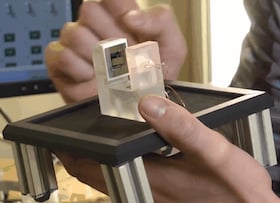 The device's 12mm-square sensor can detect minute changes in gravity. Image credit: University of Glasgow. The team used their device to measure the exertion the moon and sun place on the earth's crust, known as "Earth tides." The pull of the sun and the moon displace the earth's crust, creating a very slight expansion and contraction of the planet of around 40cm.
“One of the factors which separates gravimeters from simple accelerometers is stability, allowing users to monitor variations in gravity over the course of several days/weeks," says Dr. Giles Hammond, of the University’s School of Physics and Astronomy. "We used our [system] to monitor the Earth tides under Glasgow over the course of several days, and our results aligned perfectly with the variations in gravity the model had predicted."
Hammond says the significance of this is two-fold: demonstrating that a MEMS device can maintain its stability over a long period of time, and that a device easily built from existing mass-production technology can act as a very accurate gravimeter.
“There are a lot of potential industrial applications for gravimeters, but their cost and bulkiness have made them impractical in many situations," says phD student Richard Middlemiss. "[The device] opens up the possibility of making gravity measurement a much more realistic proposition for all kinds of industries: gravity surveys for geophysical exploration could be carried out with drones instead of planes; networks of MEMS gravimeters could be placed around volcanoes to monitor the intrusion of magma that occurs before an eruption, acting as an early-warning system."
The researchers are currently working to make the device smaller and more portable and, via UK technology hub QuantIC, are building industrial partnerships in several sectors to commercialize the technology.