New material helps teeth regrow and fortify enamel
Marie Donlon | November 30, 2025Scientists from Nottingham University have developed a new bio-inspired material that promises to regenerate demineralized or eroded enamel, strengthen healthy enamel and prevent future decay.
According to its developers, the bio-inspired, protein-based gel can be applied to teeth in much the same way dentists apply regular fluoride treatments.
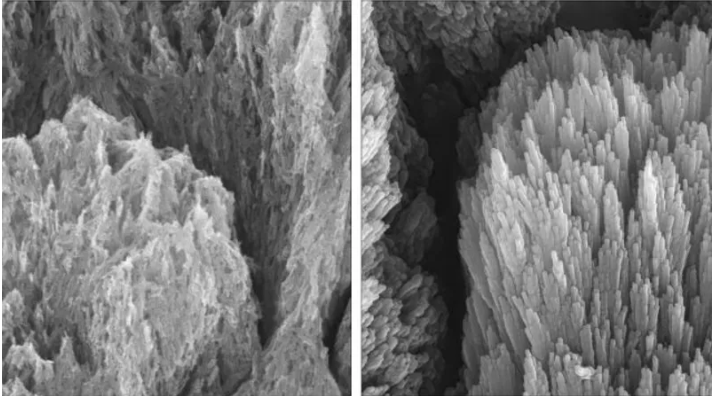 Electron microscopy images of a tooth with demineralised enamel showing eroded apatite crystals (left) and a similar demineralised tooth after a 2-week treatment showing epitaxially regenerated enamel crystals. Source: Mintech-Bio
The gel, which is fluoride free, works by replicating the features of the natural proteins that encourage the growth of dental enamel in infancy.
Once applied, the gel forms a thin and robust layer that impregnates teeth, filling any holes and cracks present in them. Then it functions as a scaffold, taking calcium and phosphate ions from saliva and promoting the controlled growth of new mineral in a process dubbed epitaxial mineralization. This process allows the new mineral to be organized and integrated into the underlying natural tissue while simultaneously recovering the structure and properties of natural healthy enamel.
The team noted that the gel can also be applied on top of exposed dentine, where it can form an enamel-like layer to treat hypersensitivity or enhance the bonding of dental restorations.
“Dental enamel has a unique structure, which gives enamel its remarkable properties that protect our teeth throughout life against physical, chemical, and thermal insults. When our material is applied to demineralized or eroded enamel, or exposed dentine, the material promotes the growth of crystals in an integrated and organized manner, recovering the architecture of our natural healthy enamel. We have tested the mechanical properties of these regenerated tissues under conditions simulating ‘real-life situations’ such as tooth brushing, chewing, and exposure to acidic foods, and found that the regenerated enamel behaves just like healthy enamel,” the researchers concluded.
The researchers intend to commercialize the gel through a start-up company called Mintech-Bio and hopes to release its first product in 2026.