Shape-memory alloys promises to help prevent damage to railroad tracks
Marie Donlon | November 15, 2025A team of researchers from the Grainger College of Engineering at the University of Illinois Urbana-Champaign are turning to shape metal alloys (SMAs) to mitigate the damage that commonly occurs with the rail ties that hold railroad tracks in their place, ensuring that their separation doesn’t change.
Because modern concrete ties tend to warp and crack through repeated use, thus leading to safety concerns like derailment if not regularly maintained, the researchers suggest that SMAs, which are metals with the ability to resume their original shape after deformation, are a possible solution for holding railroad tracks in place.
 Source: University of Illinois Grainger College of Engineering
During trials of ties warped by simulated rail traffic, the team found that they returned to their original state with SMAs activated by induction heating.
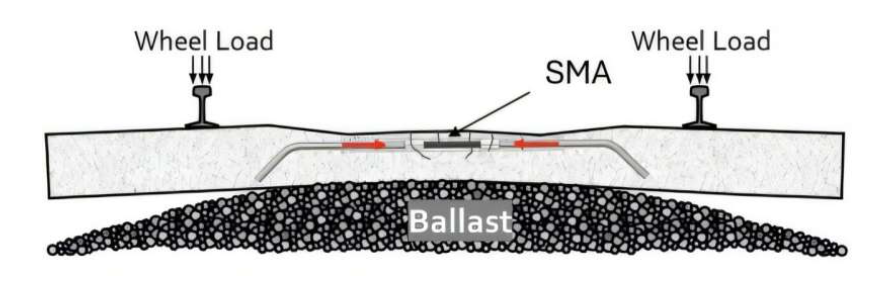
According to the team, degradation in concrete is commonly prevented through a process dubbed prestressing wherein pre-tensioned steel rods are inserted to exert forces that counteract the impacts of heavy loads. Although applied with rail ties, different parts of the tie experience different stresses. Likewise, the ties shift as the ballast — which is the gravel bed distributing weight and offering drainage — settles in response to traffic.
As such, the team believes that the SMAs are a potential solution because they can be inserted into ties then independently controlled using self-contained heat sources. The team suggests that the reinforcement they offer could rapidly adapt to the specific circumstances the tie is encountering along different locations in its structure.
"SMAs are examples of what we call 'smart materials,'" the researchers explained. "You can deform them, twist them into wild new shapes, but they retain the memory of their original state in the molecular structure. When you apply heat, they know to return to that state. So, if you just have a heat source, then the SMA can guide a concrete structure back to the desired shape stored in the alloy's memory."
Induction heating was used to restore the SMAs to their original shape via a time-varying electromagnetic field. The team did this to avoid having electrical hardware inserted inside the tie.
An article detailing the team’s work, “Experimental Testing of Concrete Crossties Prestressed with Shape Memory Alloys,” appears in the Journal of Transportation Engineering, Part A: Systems.