New bubble-driven bots could replace traditional needle injections
Marie Donlon | September 29, 2025A new technique that uses bubble-popping as a possible propulsion system for microbots, potentially leading to the replacement of needle-based drug delivery, has been developed by researchers from Zhejiang A&F University, China Jiliang University, Anhui University of Technology and the University of California, Los Angeles.
According to its developers, the idea behind the new technique is cavitation, which is the sudden collapse of bubbles in liquid. The energy produced from this process enabled the team to build tiny robots — dubbed “jumpers” — that move significant distances relative to their size.
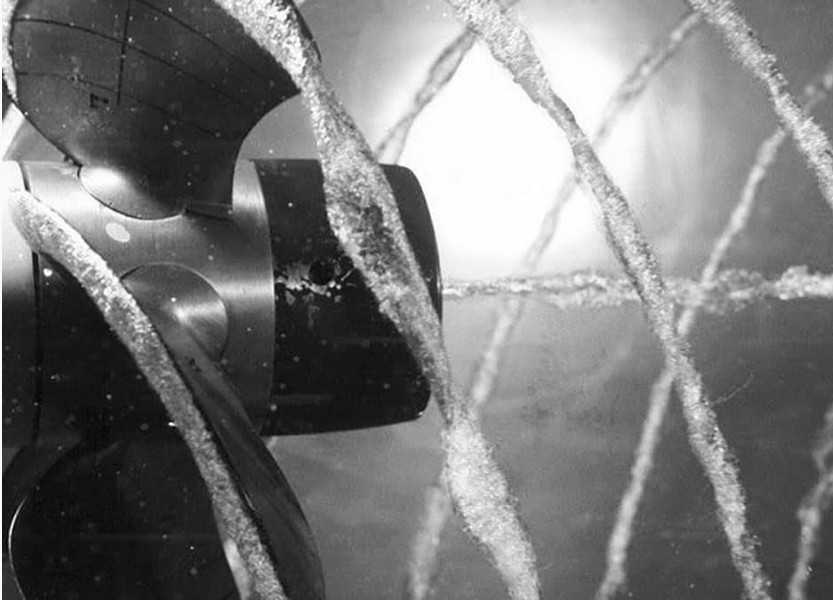 Representative image of bubble cavitation from a propellor. Source: Davidhv22/Wikimedia Commons
The team generated their own bubbles by heating light-absorbing material using a laser, explaining that the bubbles expand until they cannot hold any more energy, then violently collapse. This collapse then releases a shockwave of mechanical energy powerful enough to propel millimeter-sized devices up to 4.92 ft into the air.
Likewise, these robots can also “swim” at a speed of around 26.84 mph. “The swimming motion is highly controllable, enabling navigation through complex, confined environments such as mazes and microfluidic channels,” the researchers explained.
While cavitation is typically thought of as destructive (for instance, damaging ship propellers and pumps), the team found that by carefully controlling the laser heating, they could determine the direction of launch, height and force of the jump, while also controlling whether the device should jump, slide or “swim” in water.
One potential use case for this technique is new medical injections and drug delivery methods. In such an application, tiny cavitation-propelled devices could be launched into or through the skin, possibly replacing hypodermic needles. Such devices could also deliver drugs precisely inside the body.
Further, the cavitation-based system, which uses light-triggered heating, could potentially be tuned for minimally invasive procedures that do not need onboard power or moving parts.
The team also envisions that the so-called “jumpers,” which can travel across wet or uneven surfaces, could be used in micro-robotics designed for exploring tight or inaccessible spaces (inside pipes, machinery or biological systems, for instance).
These jumpers could also possibly used in the field of biomedical research where the tiny robots could function as micro-swimmers inside liquid environments like blood or intercellular fluid.
An article detailing the team’s work, “Launching by cavitation,” appears in the journal Science.