Breakthrough in blue: Scientists develop improved natural dye from algae
Marie Donlon | August 22, 2025Food scientists from Cornell University have created a natural blue food dye derived from algae protein that could potentially replace petroleum-based artificial food colorants.
According to its developers, phycocyanin (PC), which is a protein in algae, can reportedly be used as a blue food colorant that potentially replaces synthetic emulsifiers.
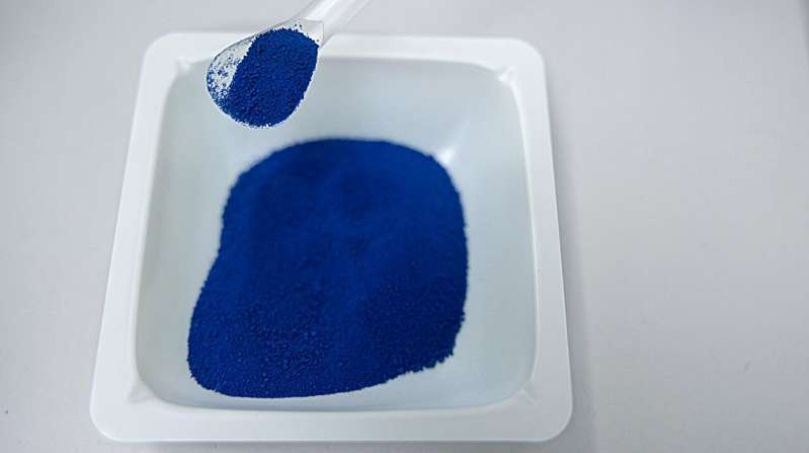 Source: Sreang Hok/Cornell University
"Consumers don't want artificial ingredients in their food," the researchers explained. "They want something healthier and more natural. Specifically, they want to see a 'clean label,' which is a major reason we have chosen to work to increase the functionality of phycocyanin as a colorant and emulsifier."
Alone, this algae-derived extract is sensitive to heat during processing and light during storage. Consequently, this lack of stability means that it is challenging to incorporate it into food formulations.
As such, the team sought to break down PC into its building blocks and develop a more stable form. To accomplish this, the team used denaturant to reorganize the large and uneven polymers into smaller, more uniform components that exhibit a higher emulsifying capacity. Once organized, the uniform particles create emulsions, which display a vivid natural blue color and enable the protection and delivery of nutrients in oil.
The results were analyzed using a technique called small angle X-ray scattering (SAXS), which was used to see the structure of materials at the nanoscale.
"It's like using a magnifying glass to see and understand changes in protein structure," the researchers explained. "Our aim is to increase the functionality of phycocyanin as a colorant, emulsifier and antioxidant, so that on the list of ingredients, it could replace multiple synthetic items."
An article detailing the dye, “Elucidating structure-functionality relationships of phycocyanin through size-exclusion chromatography coupled with in-line small-angle X-ray scattering,” appears in the journal Food Hydrocolloids.