Can phase-change materials supplant compressor cooling technologies?
Jon Lowy | August 19, 2025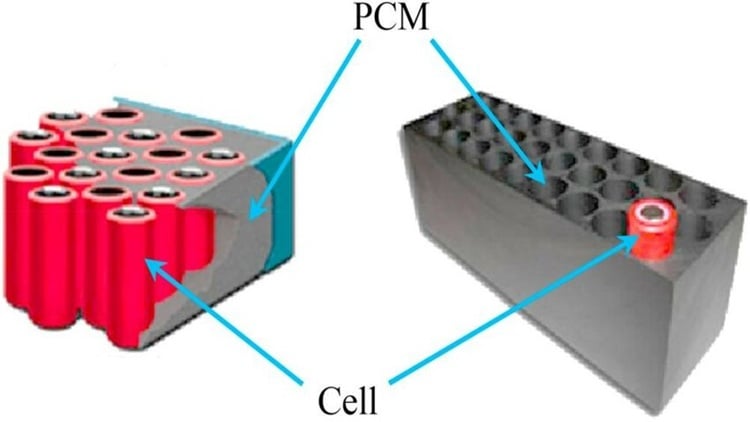 Source: CC BY 4.0
The rapid growth of lithium (Li)-ion battery use has accelerated the need for efficient thermal management systems to manage these rather delicate devices.
Maintaining battery temperature within functional limits is critical for safety, longevity and performance. Traditionally, battery cooling systems rely heavily on refrigerant compression and expansion cycles to regulate temperature. However, this approach is complex, bulky and itself energy-intensive. This is highly motivating for research into alternative cooling approaches.
Phase-change materials (PCMs) are a promising option to complement or even replace traditional compressor-based cooling in particular applications. The principles of thermal battery cooling, the potential for PCM-based systems to supplant compressors and the technical and practical challenges involved are noteworthy.
Switching to PCMs
Li-ion batteries generate heat during charge and discharge cycles due to internal resistance and electrochemical charge-discharge reactions. Excess heat degrades battery materials, reduces lifespan and increases safety risks, such as thermal runaway, particularly in the lithium-polymer (LiPo) variants of the technology. Effective thermal management aims to keep battery cells within a narrow temperature window, typically between 20° C and 40° C, under widely varying operational and environmental conditions.
Conventional battery cooling most commonly uses active systems based on refrigerant (e.g., HVAC and refrigeration) cycles. These systems can quickly dissipate heat, adapt to changing loads and provide precise temperature control. However, compressors introduce mechanical complexity, noise, vibration and consume significant electrical power, which impacts overall system efficiency.
PCMs absorb or release large amounts of latent heat during phase transitions, commonly between solid and liquid states in the form of latent heat, which stabilizes the variable temperature of the local environment. When a PCM melts, it absorbs heat at a nearly constant temperature; when it solidifies, it releases that heat in a similar fashion. This property makes PCMs excellent thermal buffer media.
Common PCMs used in this way include paraffin waxes, salt hydrates and fatty acids, each with melting/solidification points that can be chemically tailored to application needs. For battery cooling, PCMs with melting points near the desired battery operating temperature are ideal, enabling passive thermal regulation by absorbing heat when the battery temperature rises.
How PCM cooling systems work
PCM cooling systems are typically integrated, closely surrounding battery modules or packs for optimum heat transfer. As batteries heat up, the PCM surrounding the cells melts, absorbing the heat and preventing temperature spikes as the latent heat absorption occurs at constant temperature. When the battery cools down, the PCM solidifies, releasing stored heat slowly to the environment, without spiking the cell temperatures.
This passive mechanism reduces or eliminates the need for active cooling components, delivering quieter operation, reduced power consumption and lower cost cooling. PCMs typically smooth out transient temperature fluctuations until their capacity is exhausted. This thermal buffering effect protects battery cells from rapid temperature changes, within coolant system design limits.
PCM systems absorb heat without requiring process energy input, unlike electrical or mechanical compressors. This typically improves overall system efficiency, particularly in low or moderate cooling loads. With no moving parts, PCM systems require less maintenance, are less prone to mechanical failure and add less system mass-effect in mobile equipment. This increases system reliability and reduces lifecycle costs.
The absence of compressors eliminates noise and vibration, which is highly beneficial in both mobile and stationary applications, if comfort and quiet operation are priorities. As the PCM materials are embedded within battery cell interstitial spaces, the need for bulky external cooling hardware is obviated.
Challenges and limitations of PCM cooling
By now, it would be safe to ask — for PCM cooling is so novel, why isn’t it everywhere already? Despite various significant benefits, PCM cooling systems face challenges.
PCMs suffer from a limited heat removal rate. They handle heat primarily through the latent heat of the state-change to liquid, which sets an upper bound on the net energy that can be removed. Under high thermal loads or rapid cycling, PCMs may saturate (fully melt) quickly, requiring additional (active) heat dissipation mechanisms such as active or radiative cooling.
The thermal conductivity of these materials is typically low, with many PCMs being essentially good insulators. This hinders heat transfer between battery cells and PCM, slowing the maximum rate of heat uptake, which can allow temperature spikes to be less well managed. Incorporating thermal conductivity additives or using composite PCMs can improve rate-performance but adds complexity and cost.
The volume and weight of PCMs required to absorb sufficient heat for wide temperature bounds increase battery pack weight and size, potentially impacting vehicle range or device portability. While this effect may be less than that of active cooling means, the limited heat capacity may require larger volumes of PCM.
The temperature control precision of PCMs is also lacking, as they provide passive temperature regulation near their melting point. The lack of a precise temperature control capability — having a fixed liquefaction temperature — can be an argument in favor of active refrigeration systems.
Repeated phase transitions can degrade PCM performance over time due to material leakage, phase segregation or chemical degradation. Encapsulation techniques and rigorous material selection are required to ensure durability, though these solutions only extend PCM functional life for moderate periods.
Because of the limitations in heat removal rate, absolute heat removal capacity and (in some cases) temperature precision, many current thermal management strategies use PCMs in combination with active, compressor-based cooling. The PCM acts as a buffer to absorb transient thermal spikes. This hybrid approach optimizes energy efficiency and battery protection, considerably reducing both duty cycle and load on compressors. Research demonstrates significant improvements in temperature uniformity and energy consumption in such hybrid systems. PCM layers with actively-cooled liquid jackets can extend battery life while reducing overall energy consumption compared to liquid cooling alone.
While PCMs are unsuited to fully replace compressors in all battery cooling applications, ongoing research is addressing current shortcomings and broadening the application range to which they are applicable. Enhancements such as nano-enhanced composites, encapsulated microcapsules and bio-inspired materials are improving thermal conductivity, stability and energy density.
Advances in system design incorporating smart control algorithms driving hybrid cooling architectures increasingly target optimized performance and cost-effectiveness. As battery technologies evolve toward, for example, solid-state batteries or alternate technologies with inherently lower thermal outputs, the role of PCMs may become considerably more prominent.
Conclusion
Phase-change materials offer a compelling alternative or complement to compressor-based cooling systems in thermal battery management. And they could fulfill technical challenges in some important emerging markets, including EVs, grid energy storage, consumer electronics, telecommunications and robotics.
While PCMs are unsuited to fully replace compressors in all battery cooling applications, ongoing research is addressing current shortcomings and broadening the application range to which they are applicable. Enhancements such as nano-enhanced composites, encapsulated microcapsules and bio-inspired materials are improving thermal conductivity, stability and energy density.
PCMs’ ability to passively absorb and release large amounts of heat with minimal energy input makes them attractive for improving efficiency, reliability and compactness. However, challenges remain in achieving sufficient heat removal rates, thermal conductivity, volume efficiency and long-term stability. Hybrid PCM-active cooling systems currently offer the best balance for demanding applications such as electric vehicles and grid storage.
Continued material science innovations and engineering advancements will determine whether PCMs can eventually supplant compressors for large-scale battery cooling, potentially transforming how thermal management systems are designed across numerous industries.