
PCM based material for buildings stops heat in its tracks
Siobhan Treacy | September 28, 2020Researchers from KAIST in Korea have created a new heat blocking material to battle heat in buildings and keep energy costs low. Typically, insulation is used to blocking heat, but the team says that an adding an additional material could stop further heat penetration and would suppress indoor temperature, ultimately lowering a building’s overall cooling load and saving energy.
The team’s new material is a phase change material (PCM) that can help reduce heat from the outside. PCMs absorb or release heat from or to a surrounding area but do not change the temperature during phase change. Solid PCMs absorb heat as it transitions to liquid. A common PCM is paraffin oil, commonly used in candles. The team used a case to hold the PCM so when it is in a liquid phase it will not leak. This makes it possible to apply the PCM case to a building wall and block heat from entering.
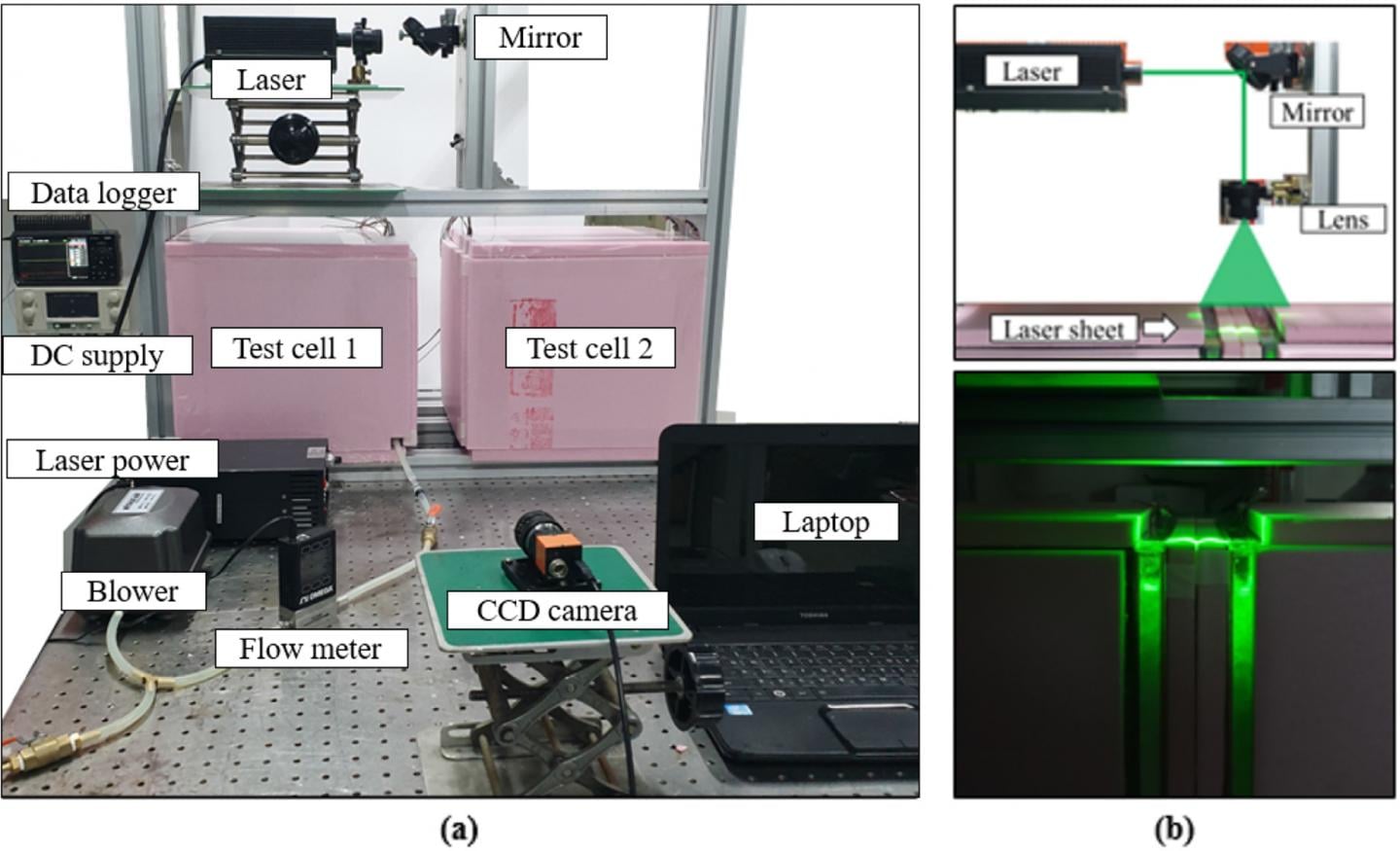 (a) the experimental device (b) the laser module for fluid flow visualization. Source: KAIST
But PCMs do not melt evenly from the outside to the inside during phase transition from solid to liquid. As PCMs turn liquid from the outside inwards, the hot areas make their way up and the cool parts move down. This means that heat will penetrate into a building through an area where the PCM is in a liquid phase, ultimately making PCMs ineffective in controlling indoor temperature.
The team addressed the non-uniform phase change by injecting bubbles into the PCM. Bubbles are injected into the bottom part of the PCM during the phase transition, which encouraged uniform PCM circulation in the liquid phase. This ultimately resulted in the PCM melting in a uniform manner and blocking heat penetration across the entire wall.
A paper on the new material was published in Energy Conservation and Management.

For this to work you would need several layers of wax with progressive melting points, the wall panel would be thick, several inches, and heavy, in the hundreds of lbs....then the wall would become a heater...I don't see this as being cost effective for temperature regulation, but would need some testing for proper data....