Airbus Wants Humanoid Robots for Airliner Assembly
Engineering360 News Desk | February 18, 2016Automating aircraft assembly is difficult because most robots aren’t nimble enough to perform the required tasks. Airbus group says it hopes to change that through humanoid robotic technology that adapts to assembly environments.
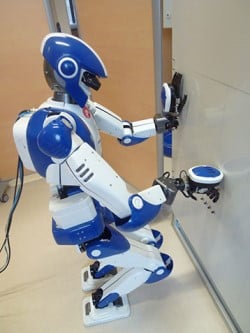 Humanoid robots will adapt to various postures demanded by aircraft assembly. Image source: Joint Robotics Laboratory (CNRS/AIST)The aircraft manufacturer is collaborating with the Joint Robotics Laboratory (JRL), which will use its HRP-2 and HRP-43 human-sized robot models to develop a technology called multi-contact locomotion. By using its entire body to make contact with its environment, an anthropomorphic robot can climb ladders and enter confined spaces common to aircraft assembly. Multiple points of contact also make it possible to increase a robot's stability, as well as the force it can apply when executing a task.
The cramped and inaccessible spaces necessitate the humanoid robot to conform to different postures. Researchers will establish algorithms to enable flexibility and dexterity while keeping calculations fast so that the robot’s movement remains efficient. New algorithms to plan and control precise movements will help the robots avoid collision with surrounding objects.
Humanoid robots eventually may complete tasks such as tightening bolts, cleaning metallic dust and inserting parts into the airplane’s structure. The units also might be able to verify that systems function properly once manufacturing is complete.
JRL will test the algorithms on a set of use-cases drawn from different Airbus divisions. Researchers believe their work could define specifications for the first generation of humanoid robots dedicated to large structure manufacturing in the next 10 to 15 years.
The Joint Robotics Laboratory is a research program between Japan’s National Institute of Advanced Industrial Science and Technology (AIST) and France’s National Centre for Scientific Research (CNRS).