Power-dense pancake motors in compact packages
June 16, 2025Axial flux (AF) motors remove the rotating member that is necessary in the more commonly used radial flux (RF) motors to generate a higher torque within the same footprint as a radial motor. In RF motors, the magnetic flux path travels in a two-dimensional path, radially outward: from one internal rotor pole to the closest stator tooth, through the stator yoke (back iron), to the next stator tooth and back to another rotor pole. The magnetic flux AF motors move along the shaft axis in a straight path from one pole, through the air gap, to another pole, for a stronger magnetic field. This enables a yokeless design with inherently high-power density and efficiency.
Pelonis Technologies has three different series of AF — or pancake — motors that are frequently used in high-reliability, high-end servo applications: the GP (general purpose) series, GM (high-precision compact) series and GN (high-precision slim) series.
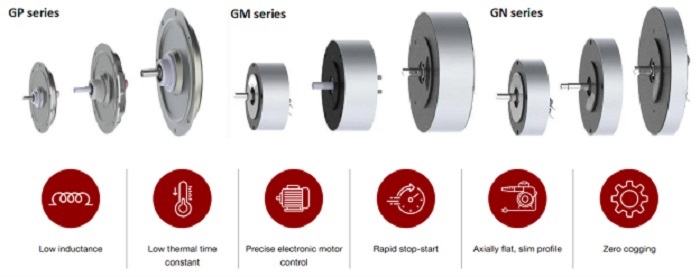 Figure 1: Pelonis’ GP, GM and GN series of pancake motors. Source: Pelonis Technologies
Due to their inherent advantages, the high-precision motion control and lightweight design of these motors make them well-suited for medical and aerospace applications. Medical use cases include scientific instrumentation, scanners, centrifuges, imaging, pumps and medical mobility.
Aerospace applications can span from flight simulators to compact aircraft, drones and electric vertical takeoff and landing aircraft. Aerospace systems must always maximize size, weight and power, making the pancake motors an ideal choice. These systems often rely on direct-drive motors since the gearless design will reduce maintenance, size, weight, inertia and the overall complexity of the motor.
 Figure 2: Pancake motors can maximize the size, weight and power performance of aerospace and defense technologies with its optimal power density and efficiency. Source: Pelonis Technologies
As shown in Table 1, each of these pancake motors feature a unique magnet technology that will optimize various aspects of each series. The GP series includes standard ferrite (GPM) or high-power neodymium (GPN) magnets for a more economical servo solution.
| GP | GM | GN | |
| Magnet options | GPM, GPN | ALNiCo | NdFeB |
| Applications | General industrial | Battery-powered, low voltage and high-speed | Space-constrained, batter-powered, low-voltage and high-speed |
| Armature diameters | 9 cm, 12 cm, 16 cm | 9 cm, 12 cm, 16 cm | 9 cm, 12 cm, 16 cm |
| Operating temperature | Up to 150
o C | Up to 150
o C | Down to -20
o C |
Table 1: Characteristics of GP, GM and GN series.
The GM series features a printed armature and high-power ALNiCo magnets and has an available low resistance (LR) (i.e., parallel winding) motor optimized for low-voltage, battery or high-speed applications with perfect control.
The GN series uses rare-Earth NdFeB magnets and is one-third the axial thickness of the GM range, making it one of the flattest motors available. Through the use of the NdFeB magnets, the GN portfolio can operate in temperatures as low as -20o C, making it ideal for the high-altitude aerospace applications. The GN series also has an LR option for low-voltage, battery or high-speed applications.
The Pelonis advantage
For over 25 years, Pelonis Technologies has offered high-quality products at competitive costs and with flexible manufacturing techniques that enable small- or large-scale requirements. Contact Pelonis Technologies to learn how they provide customers with significant value-added services, ready solutions or custom designs.