Bouncing into action: US scientists develop seed-tossing shells without motors or electronics
Marie Donlon | June 25, 2025A team of researchers from North Carolina State University has developed so-called “jumping metashells,” which are new autonomous robotic structures capable of bouncing into the air without a remote control.
According to its developers, these jumping metashells, which could potentially be used in the future for seed dispersal in agricultural fields, do not rely on external stimuli to achieve bounce. Rather, the timing and height of their jumps are reportedly built into their physical structure.
 Source: North Carolina State University
“There are structures that ‘jump’ immediately when loading is removed — such as when a coiled spring is released. We wanted to create a structure that does not rely on external stimuli and allows us to dictate the jump timing in advance. We have developed a technique that allows us to precisely schedule when the structure leaps into action, whether in seconds or hours,” the researchers noted.
The team built the structure by weaving strands of polyethylene terephthalate (PET) into a complex lattice. Once a load is applied, the structure will deform, storing energy. Thanks to the viscoelastic properties of PET, the structure does not instantly snap back.
The researchers explained that when and how high the metashell jumps is determined by how long the load is applied. Specifically, the longer the load, the longer the delay and the lower the jump, they noted.
“The result is that if you apply a load to our spherical metashell, it is compressed into a shape like a flower bud. When the flower bud snaps back into the spherical shape, the release of energy hurls the structure into the air. And you can dictate exactly when that jump will happen by controlling how long the load is applied to the structure. This also controls how high the metashell jumps, because the longer the load is applied, the less high the metashell will jump,” the team added.
During trials, the metashells were programmed to jump on a predetermined schedule that ranged from three seconds to 58 hours. Likewise, the height of those jumps was also controlled, with the metashells leaping up to nine times or as little as half their height, depending upon the length of the scheduled delay.
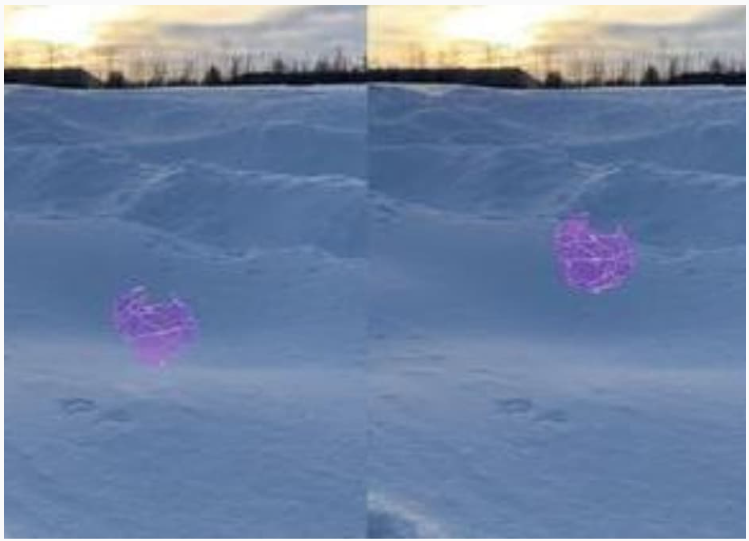
Further, the metashells were capable of jumping on assorted surfaces, including solid ground, sand, snow and water, and at temperatures under 15° C.
In a demonstration of its seed dispersal capabilities, the metashell was loaded with seeds and dispersed over a wide area, allowing for a uniform dispersal where the seeds germinate and grow, the researchers reported.
During those trials, a 100-millimeter metashell dispersed seeds across an area of 1.5 meters.
The team's findings are detailed in the article, “Programmable seconds-to-days long delayed snapping in jumping metashell,” which appears in the journal Proceedings of the National Academy of Sciences.
For more on the jumping metashells, watch the accompanying video that appears courtesy of North Carolina State University.