Rolling Out Nanobrushes Like Sod
Riia O'Donnell | March 30, 2016From eyeglasses that resist smudging to keeping the undersides of ships from corrosive decay, polymer nanobrushes have been used to stave off germs and keep unwanted accumulation from forming on surfaces.
A team of material scientists from Drexel University in Philadelphia has looked at the process for creating polymer brushes and believes they’ve improved on it. The team likens the two existing methods to create the brushes to planting crops: “grafting-from” sprinkles seeds on soil to take root, while “grafting-to” transplants individual plants.
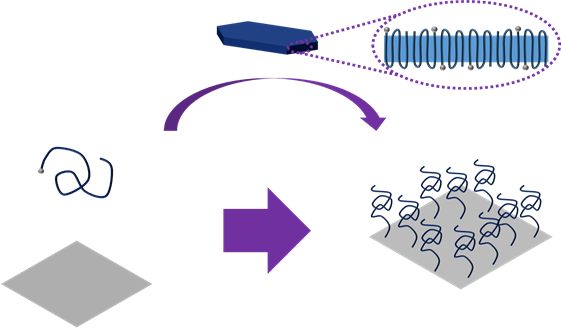 Growing nanobrushes like sod. Image source: Drexel UniversityUsing that model, they say they believe they can create the brushes faster and more efficiently by rolling them out like sod. The method also may allow for higher levels of control over the shape of the brush and the bristles.
To achieve this, the scientists grow a functional, two-dimensional sheet of polymer crystals, then adhere it to a substrate. When the crystals are dissolved, the polymer chains pop up, forming the bristles. The technique allows precise tuning of brush characteristics, based on the control of the formation of the two-dimensional structure on the crystal sheets. The work has yielded densely packed polymer brushes with bristles less than a nanometer apart.
The team also has created polymer crystals with anchor points on both ends, which form a loop to create a sturdier bristle formation.
Grown bristles could go beyond their current uses in coating, biomedical, sensing, and into markets that extend the life of a variety of materials.