UV chip eliminates bacteria to extend food freshness
Marie Donlon | May 12, 2025Collaborators from the LUMINOUS! Center of Excellence for Semiconductor Lighting and Displays at Nanyang Technological University, Singapore (NTU Singapore) and Sweden’s PureFize Technologies, have developed a UV chip that eliminates microorganisms such as bacteria, fungi and viruses.
According to its developers, the chip was integrated into a commercially available product designed to preserve the freshness of food stored in containers.
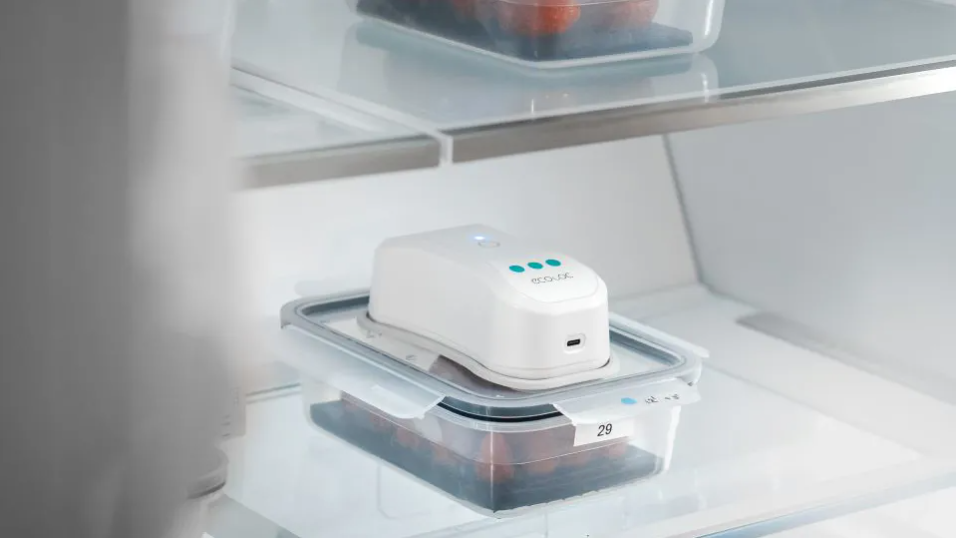 Source: PureFize Technologies
“Our chip is a significant breakthrough in health and safety as it has the potential to eradicate harmful food spoilage microorganisms as well as reduce the spread of infectious diseases such as COVID-19,” the collaborators explained.
Unlike traditional UV lamps, the chip does not require mercury and is just a few centimeters in size. Likewise, it also operates at full intensity in small, confined spaces without the need for cooling.
The team noted that the most effective UV light for inactivating microorganisms is short wave UV (UVC), which damages DNA and kills microorganisms. While mercury lamps that emit UVC are typically used to disinfect water and air, due to its high toxicity, they are fast being phased out.
As such, the chip produces UVC through cathodoluminescence rather than vaporizing mercury to create UV light, as is done in mercury lamps. The chip features a cathode composed of ZnO nanostructures along with an anode coated with a material that emits mostly UVC when excited by electrons. Meanwhile, when a voltage is applied, electrons are emitted from the cathode via field-emission, then subsequently accelerated in a vacuum by the electric field toward the anode, which then emits UV light when targeted by the electrons.
According to the researchers, the chip emitted UVC around a wavelength of 265 nm, while another portion extended into the UVB (280 nm to 315 nm) and UVA (315 nm to 400 nm) regions. Altogether, this combination reportedly leveraged UVC to disturb DNA while UVB and UVA penetrated and destroyed difficult-to-eradicate communities of biofilms and cellular components like proteins and lipids.
In the lab, the UV chip reduced pathogenic waterborne bacteria Pseudomonas aeruginosa, Escherichia coli and Legionella pneumophila after just a few minutes of irradiation. Additionally, the UV chip eliminated the virus that causes COVID-19.
“The disinfection efficiency of our chip is on a par with conventional mercury lamps, and we are excited about the potential applications of the device in consumer products, including food containers, refrigerators, and medical technology applications," the researchers.
The team incorporated the chip into a commercially available handheld device dubbed EcoLoc, which is designed to be used with a specially developed food container lid — specifically, the kind that fits the IKEA series of 365+ food storage containers — to keep food safe.
Paired with the specialized container, the chip extended the shelf-life of perishable foods — including bread, fruits, vegetables and meats — to almost a week with just minimal impact on the taste and odor of the foods.
The development is detailed in the article, “On-Chip Mercury-Free Deep-UV Light-Emitting Sources with Ultrahigh Germicidal Efficiency,” which appears in the journal Advanced Optical Materials.