Switzerland's high-tech GoldenPass Express train
Ryan Clancy | April 03, 2025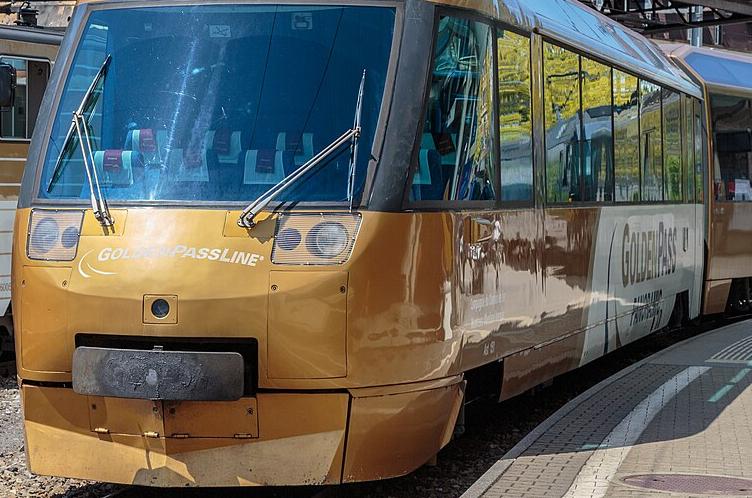 CC 4.0 JoachimKohler
Swiss rail projects tend to conjure up thoughts of breathtaking alpine scenery and the tunnels that cut under that scenery. At 35 miles (57 km) in length, the Gotthard Tunnel and all of its many geologically based engineering challenges come to mind.
Of course, not every engineering project in this beautiful alpine nation involves boring through the heart of the Swiss Alps. In fact, this article, detailing the core engineering problems, and solutions, behind Switzerland’s GoldenPass Express train project won’t talk about tunneling at all. We’re moving away from the dirt and geological extremes, focusing instead on what it took to engineer a means of transitioning between two incompatible track gauges, without forcing passengers to switch trains, we might add.
What is the GoldenPass Express train
It’s a high-tech rail link that connects Montreux and Interlaken. As it’s a direct link, no stopping at a station to switch trains required, it offers what’s being described as a seamless journey across the Swiss Alps. That simple word might not seem important right now, but hold on as we explore the engineering innovations required to make this project a reality. They’ll include such train specific features as a variable gauge bogie system and an automatic height adjustment ramp, to ensure smooth transitions.
What’s the gauge-shifting historical context
The main challenge facing engineers constructing the GoldenPass Express was the existence of two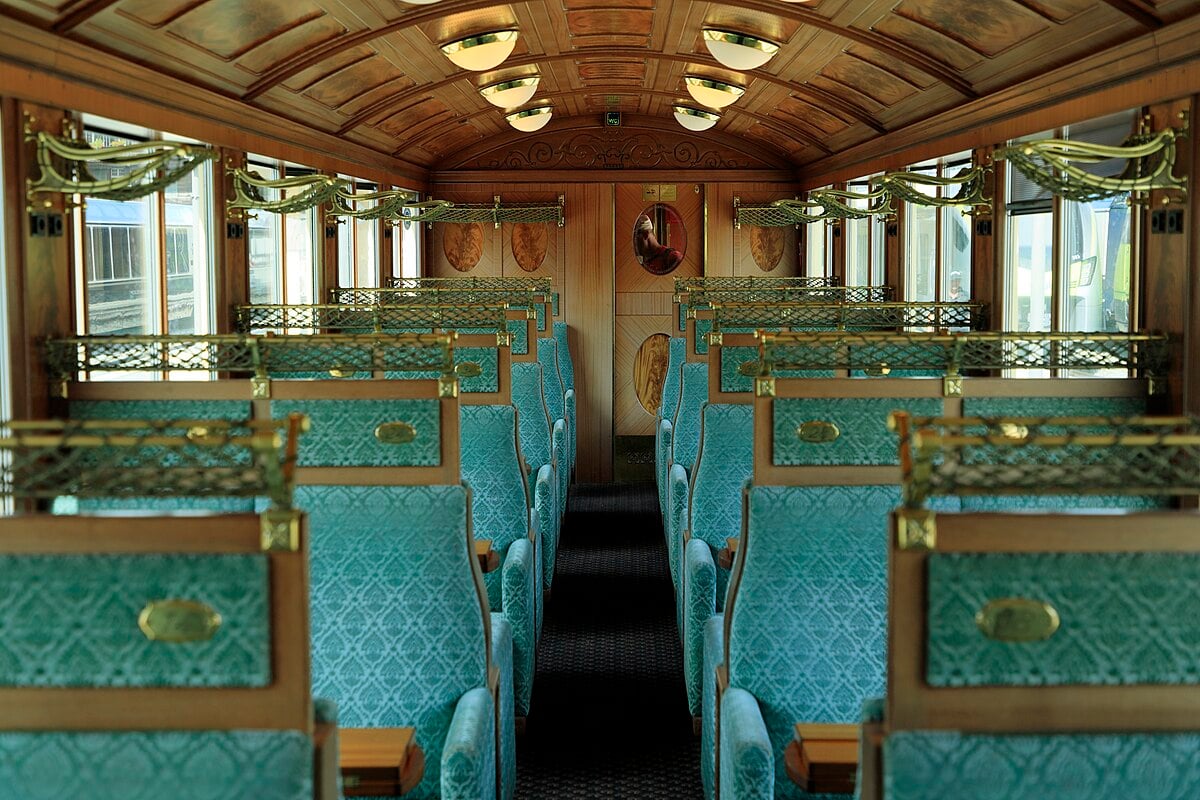 Classic style interior with luxury add ons. CC 4.0 Falk2 distinctly different rail gauges along the route. The Montreux to Zweisimmen section uses narrow gauge tracks (1,000 mm), while the Zweisimmen to Interlaken section uses standard gauge tracks (1,435 mm). The trains.com link provided here describes the history of standard gauge, why it rose to prominence internationally.
To summarize the other side of the issue, the late 19th century saw the Montreux–Berner Oberland Railway (MOB) adopt a narrow gauge rail system, citing cost-effectiveness reasons. The terrain in this area of the Swiss Alps is steep and rugged, with sharp curves and significant elevation changes, after all. The two gauges are not compatible, not without much labor and required passengers waiting around for a locomotive equipped with the other rail gauge, narrow or wide. Fast forwarding to today, traditional solutions to mixed gauge transitioning were not in the cards. No time-consuming manual bogie swaps and no passengers waiting in the cold alps to change trains. None of that aligns with the GoldenPass Express’s goal of an uninterrupted journey. A seamless transition mechanism that would allow a single train to shift between the two gauges without stopping, that was the only acceptable solution.
Enter the variable gauge bogie system
Developed by a European engineering company called PROSE, the prototype EV09 mixed gauge bogie was tested and delivered in 2010 to the Montreux–Berner Oberland Railway (MOB), eventually evolving into the EV18. The timeline for this evolution can be found here, leaving readers to wonder exactly what refinements were introduced over a span of eight years. That’s how long the developmental phase, prototype to final engineered mechanism is marked down as, but we’ll put this lengthy phase down to legendary Swiss engineering precision.
As for the design, not much information could be gleaned on the principles and mechanisms assembled into the final design of the EV18, but there is some interesting project management literature available on the EV09 prototype. Essentially, the train approaches Zweisimmen Station at 15 km/s, the transition zone is entered and the moving components in the bogie mechanism are unlocked. Two half frames then slide laterally, moving 435 mm relative to one another. The result is a smooth and seamless changeover from metric to standard gauge, or vice versa.
There’s a second and third transition taking place at the switchover area. For one thing, flaps come up a preset distance, allowing a gauge-adapting ramp — slowly changing the platform accommodating height from 35 cm to 55 cm — to raise or lower the train so that it arrives at Zweisimmen at the correct level for disembarkation, then there’s the issue of voltage changing to deal with, as noted in this GoldenPass Express PDF. On page 14, there’s a note detailing the change from 900 V direct current (DC) on the metric line to 15 kV AC on the standard gauge line. A replacement locomotive solves this challenge.
Solving the mixed grade conundrum with European innovation
None of this gauge-switching engineering wizardry is visible to the passengers. They’re aware of the eight-minutes taken to switch locomotives, maybe of the few seconds it takes to climb or descend the ramp. Do they experience a subtle vibration as the wheels unlock and the half frames smoothly shift laterally at the axle changeover facility? Questionable, but we guess we’ll have to take the journey from Montreux to Interlaken to be sure. It would be a fascinating trip.
Regular passengers, though, will be more preoccupied by the nose of the train, conceived of by Italian designer PininFarina, by the panoramic views offered by Prestige Class seating. Even if the locomotive switch and slight ramp incline makes the GoldenPass Express slow to 15 km/h as it pulls in toward Zweisimmen Station, only the engineers among them will be picturing the intricate mechanics at play beneath the sleek exterior. In their mind's eye, they’ll be envisioning the precision engineered gauge-changing system, the synchronized locking mechanisms and the careful weight distribution that allows for such a seamless transition between track widths.
For everyone else, the journey focuses on comfort and caviar, assuming they've opted for the indulgence of Prestige Class. Meanwhile, the long-term future of the tourism-heavy route is assured. We even found this article at railwaygazette.com. It signals confidence in the future of the route, and of the technology used to vary gauge, metric to standard gauge, while on the move. The article details how, as of October 2024, Montreux-Berner Oberland-Bahn (MOB) placed an order for six state-of-the-art locomotives from Stadler. Four of them will be dedicated to passenger conveyance on the GoldenPass Express, the other two will be used for maintenance purposes.
These dual-cab, hybrid-electric locomotives are set to enter service by 2028, ensuring the seamless operation of this iconic route for years to come. While passengers sip their wine and admire the Alps, the engineers behind the scenes are making sure the GoldenPass Express keeps gliding into the future, on whatever tracks it pleases.