
The Transcontinental Railroad at 150
David Wagman | May 08, 2019One of the great infrastructure investments in American history was the construction of the Transcontinental Railroad, which was completed on May 10, 1869, with the driving of a final "golden spike" at Promontory Summit near Ogden, Utah.
The rail link was a 1,912-mile (3,077 km) continuous railroad line built between 1863 and 1869. It linked the existing eastern U.S. rail network at Omaha, Nebraska/Council Bluffs, Iowa, with the Pacific coast at the Oakland Long Wharf on San Francisco Bay.
 The iconic A.J. Russell image of the celebration following the driving of the "Last Spike" at Promontory Summit, Utah, May 10, 1869.The rail line was built by three private companies over public lands provided by U.S. land grants. It is heralded by historians as perhaps the most significant infrastructure investment ever made to open the American West for rapid settlement and development.
The Western Pacific Railroad Company built 132 miles of track from Oakland/Alameda to Sacramento, California. The Central Pacific Railroad Company of California (CPRR) built 690 miles from Sacramento to Promontory Summit, Utah Territory. The Union Pacific built 1,085 miles from its eastern terminus at Council Bluffs near Omaha westward to Promontory Summit.
The railroad opened for traffic on May 10, 1869, when CPRR President Leland Stanford drove a ceremonial last spike. The railroad connection made transporting passengers and goods coast-to-coast much faster and less expensive. Cross-country wagon trains and arduous ocean voyages around South America were made a thing of the past.
The first transcontinental rail passengers arrived at the Pacific Railroad's western terminal on Sept. 6, 1869.
Rolling steam
To mark the Golden Spike anniversary, the Union Pacific Railroad spent five years refurbishing the last operating "Big Boy" steam locomotive at its rail yards in Cheyenne, Wyoming. The engine — No. 4014 — departed Cheyenne in early May to take part in the commemorative ceremonies.
According to the Union Pacific, 25 Big Boys were built for the railroad. The first was delivered in 1941.
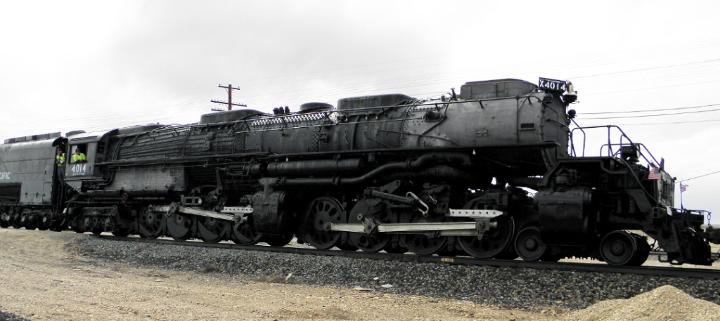 UP locomotive 4014 "Big Boy." Source: Union PacificThe locomotives were 132 ft long (roughly half the length of a Boeing 747) and weighed 1.2 million pounds. Because of their length, the frames were hinged, or articulated, to allow them to negotiate curves.
They had a 4-8-8-4 wheel arrangement, which meant they had four wheels on the leading set of "pilot" wheels that guided the engine, eight drivers, another set of eight drivers, and four wheels following which supported the rear of the locomotive. The engines normally operated between Ogden, Utah, and Cheyenne.
Seven Big Boys are on public display around the country. They can be found in Denver; Dallas; St. Louis, Missouri; Omaha, Nebraska; Scranton, Pennsylvania; Green Bay, Wisconsin; and Cheyenne, Wyoming.
Big Boy No. 4014 was delivered to Union Pacific in December 1941. It was retired in December 1961, having traveled more than 1 million miles in its 20 years in service. Union Pacific reacquired No. 4014 from the RailGiants Museum in Pomona, California, in 2013, and relocated it to Cheyenne to begin the multi-year restoration process.
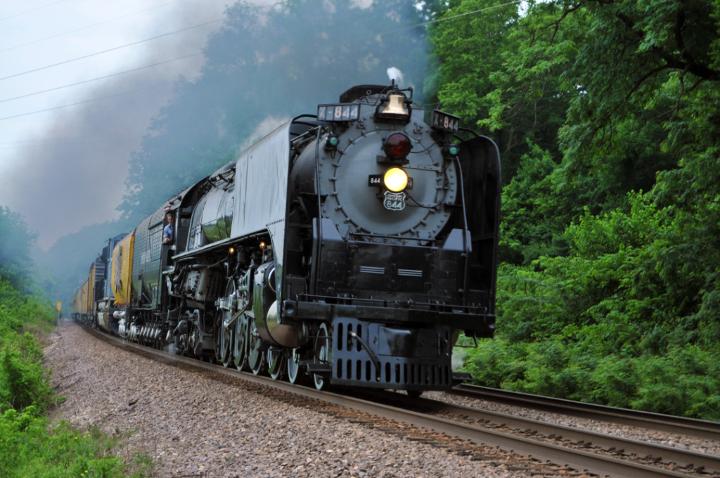 UP No. 844 in June 2010. Source: Union PacificAlso taking part is UP's steam locomotive No. 844, the last steam locomotive built for the railroad. It was delivered in 1944.
The Northern class steam locomotives — which includes No. 844 — had a wheel arrangement of 4-8-4, and were used by many large U.S. railroads in dual passenger and freight service. Union Pacific operated 45 Northerns, built in three classes, which were delivered between 1937 and 1944. The locomotive were capable of speeds in excess of 100 miles per hour.
Supply chain challenges
The Central Pacific broke ground on its segment of the Transcontinental Railroad in January 1863. Virtually all of the necessary tools and machinery were transported first by train to east coast ports. The equipment then was loaded onto ships which either sailed around South America's Cape Horn, or was offloaded at the Isthmus of Panama, where it was transferred to ships on the Pacific Ocean via paddle steamer and the Panama Railroad.
Once the equipment reached the San Francisco Bay area, it was loaded onto river paddle steamers which transported them up the final 130 miles of the Sacramento River to the new state capital in Sacramento.
Meanwhile, in the east the Union Pacific Railroad did not start construction until July 1865. Work was delayed by difficulties arranging financial backing and labor and material shortages due to the Civil War. Equipment needed to begin work was initially delivered to Omaha and Council Bluffs by paddle steamers on the Missouri River.
At that time, two primary standards existed for track gauge, or the distance between the two rails. In England, the standard gauge was 4 ft 8.5 in. This had been adopted by most northern U.S. railways. Much of the south, however, had adopted a 5 ft gauge. For the Transcontinental Railroad, the builders adopted the English standard, what is now called standard gauge.




That is impressive for that era. Couldn't have been easy. I'd bet a lot of people said, "Where're we gonna get all that iron/steel?". And that was just the beginning.
An interesting part of the ceremony, was the instant communication to the rest of the country via telegraph.
On pages 26 and 27 of the May TRAINS issue: At 12:47pm on May 10, 1869, "The silver spike maul on the [David] Hewes golden spike, resting on the south rail, completed a circuit sending a telegraph message east and west, setting off cannons and bells in cities and towns from coast to coast." Sort of like going "viral" today . . .
What was it the engines said
Pilots touching head to head
Facing on a single track
Half the world behind each back
I can't remember who wrote that. I just saw ir 65 years ago. JHF