Plasma Barrier for Injection Molding
Engineering360 News Desk | March 14, 2016Germany’s Waldorf Technik, GmbH & Co. has created a barrier technology for injection molding.
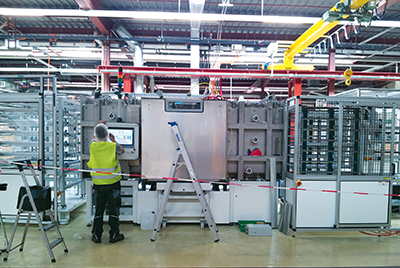 The Waldorf Technik 3D coating system. The process places a plasma-enhanced chemical vapor deposition coating (PeCVD) onto a part. The coating, Cavonic 3-D, acts as a barrier to gases, vapors and chemicals, protecting food and extending shelf life by preventing oxidation. The company says the barrier coating doesn’t add weight to the product and can be used in hot-fill and retort processes, as well as high temperature and sterilization. The coating also eliminates the need for multi-barrier structures, which will allow a container access to common recycling processes.
Although the Cavonic system is similar to PeCVD processes to blow mold PET bottles, the company says the application of the barrier is different. Its process can coat hundreds of parts at once, rather than coating each part individually. This feature could result in a reduction of costs of 70-80 percent, the company claims.
The company says it believes this is the first system designed for injection molding wide-mouthed containers, or containers with spouts or tube shoulders. The system places a layer of silicon dioxide in a glass-like layer on the part surface. To use the process in fast-cycling injection molding, the process takes three to four minutes because the parts are treated in batches.
Testing reveals that parts heated to 446°F for one hour and cooled to -108°F have maintained their barrier properties after completing the process. Impact testing also verified that the barrier remains intact due to covalent bonding to the polymer.