Robot screens solar cell composition
S. Himmelstein | September 24, 2024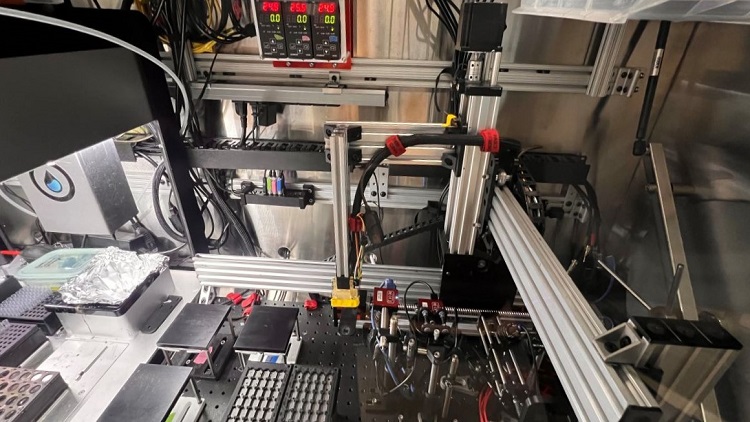 The automated material discovery and testing platform for tandem perovskite solar cells. Source: Kelly X. Vences/University of California San Diego
Automation has come to tandem perovskite solar cell material discovery and testing platform for tandem perovskite solar cell technologies. The robotic platform has been engineered by University of California San Diego researchers to mix precursors and conduct spin coating, annealing and analysis of optoelectronic thin films.
The Perovskite Automated Spin Coat Assembly Line (PASCAL) system can perform up to 430 sample depositions or measurements per day. The system can also screen and evaluate 58 different materials based on triple-halide, triple-cation compositions. “PASCAL automates fabrication of thin films by the standard spin coat procedures employed in manual processes, albeit with precision, control, and record keeping surpassing that of human operators,” said the researchers.
The research detailed in Digital Discovery confirms the utility of PASCAL's repeatability to address sensitive processing parameters known to challenge halide perovskite fabrication, such as anti-solvent drop timings. With PASCAL, users can identify and minimize the influence of previously hidden variables, such as solvent partial pressure, and achieve a high level of repeatability. Machine learning was applied to develop and prototype a durable composition that displays nearly zero photoluminescence peak shifts under both 85° C and approximately 4-sun photoexposure.