Starfish-inspired structure will bend and mend
Marie Donlon | July 15, 2024The structure, which reportedly exhibits 4D features, promises to offer assorted possible applications for robotics, aviation and medical devices.
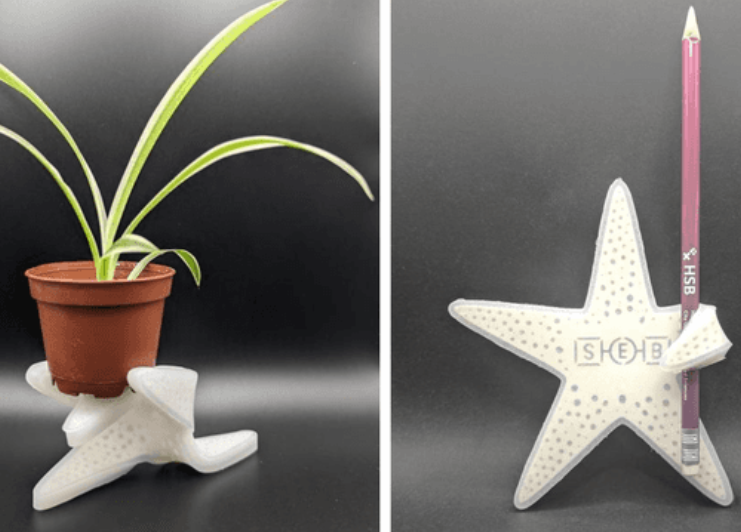 The starfish-inspired morphing structure holding a pot in 1 and pencil in 2. Source: Raman Raman
Taking inspiration from starfish, which possesses the ability to hold themselves in any type of body posture thanks to its skeleton composed of a network of diverse tissues, the team used advanced imaging techniques (X-ray CT scans), computational modeling (multi-body and finite element simulations) and detailed image analysis to mimic its structure.
To translate the biological design of the starfish into an engineering material, the researchers 3D printed thermoplastic mesh similar to ossicles — which are calcite microstructures within starfish bodies that are connected in a network via collagen fibers to form the endoskeleton — which allows them to hold a wide variety of body postures while expending very little energy.
According to the researchers, this enables starfish to achieve “self-locking, continuous bending, self-healing, and shape memory features."
By leveraging the design of the starfish, the researchers were able to replicate material that bends smoothly and continuously, even into complex curves.
Further, the team managed to reproduce the starfish’s ability to self-heal when damaged. The team explained that the material flows and fuses when heated above the thermoplastics’ melting point.
The team is eyeing the material for use in car seats that potentially adapt their shape to a person’s body as well as surgical tools that might be inserted in a minimally invasive form and eventually expand and reshape themselves at the surgical site.
Other possible applications for the material include prosthetics, traditional plaster casts and splints that are re-shapeable with the application of heat. The material could even be used for spacecraft structures, emergency shelters and next-gen robots.
“For instance, a search-and-rescue robot could squeeze through tight spaces to reach trapped individuals, while a robotic arm could gently grasp and manipulate fragile objects without causing damage,” the researchers noted.