NASA Developing a Piloted, Electric-Powered Aircraft
By Engineering360 News Desk | March 09, 2016NASA is researching the development of an electric propulsion-powered aircraft that would be quieter, more efficient and environmentally friendlier than today's commuter aircraft.
The proposed piloted experimental airplane is called Sceptor, short for the Scalable Convergent Electric Propulsion Technology and Operations Research. The concept involves removing the wing from an Italian-built Tecnam P2006T aircraft and replacing it with an experimental wing integrated with electric motors.
An advantage of modifying an existing aircraft is that engineers will be able to compare the performance of the proposed experimental airplane with the original configuration, says Sean Clarke, Sceptor co-principal investigator at NASA's Armstrong Flight Research Center, in California. The Tecnam, currently under construction, is expected to be at Armstrong in about a year for integration of the wing with the fuselage. Armstrong flew a different Tecnam P2006T in September to gather performance data on the original configuration.
NASA scientists envision completion of a nine-passenger aircraft with a 500-kilowatt power system by 2019. To put that in perspective, 500 kilowatts (nearly 700 horsepower) is about five times as powerful as an average modern passenger car engine.
However, to reach that goal NASA researchers intend to have a version of the Sceptor operational in the next two years. Progress in three areas is happening now to enable that timeline: testing an experimental wing on a truck, developing and using a new simulator to look at controls and handling characteristics of an electric airplane and verifying tools that will enable NASA's aeronautical innovators to design and build Sceptor.
The first of those jobs involves the Hybrid Electric Integrated Systems Testbed (HEIST), an experimental wing initially mounted on a specially modified truck that is used for a series of research projects intended to integrate complex electric propulsion systems. The testbed functions like a wind tunnel on the ground, accelerating to as much as 73 mph to gather data.
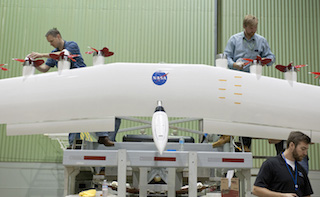 Sean Clarke (l), Kurt Papathakis and Anthony Cash (foreground) work on an experimental wing. Image credit: NASA."By evaluating what we measured, versus what the computational fluid dynamics predicted, we will know if the predictions make sense," Clarke says. "Since Sceptor is a new design, we need to validate [that] we have good answers for the Sceptor experimental wing."
HEIST's first experiment began in May 2015 at Armstrong and consisted of integrating 18 electric motors into the carbon composite wing with lithium iron phosphate batteries. Tests have shown the distribution of power among the 18 motors creates more than double the lift at lower speeds compared to traditional systems.
Developing and refining research tools are another major endeavor. Researchers are now integrating Sceptor aircraft systems with an Armstrong flight simulator for pilots to evaluate handling qualities. They will also study balancing the power demands of the motors with batteries and then a turbine to find out if a hybrid of distributed electric motors and gas-powered turbines can provide power to extend the aircraft's range and enable the envisioned nine-place concept aircraft.
If progress continues apace, NASA believes Sceptor could realize greater fuel efficiency, aircraft noise reduction and improved performance and ride quality.